

Click the + buttons to open your bonuses:
Part One – Why Family First
SECTION 1 – The Why
Books to Dive Deeper:
The Meaning of Your Life: Finding Purpose in an Age of Emptiness by Arthur C. Brooks
https://www.amazon.com/Meaning-Your-Life-Finding-Emptiness/dp/0593545427/
Arthur C. Brooks examines why a life filled with activity, comfort, and achievement can still feel strangely empty. Drawing on social science, philosophy, and his work on human happiness, he argues that meaning grows from understanding the deeper “why” beneath our choices—not simply becoming more productive or successful. It is a natural companion to Michelle’s realization beside the lake in Pokhara: a meaningful life is not something you collect through experiences. It is something you build through purpose, relationships, and commitment to what matters most.
Build the Life You Want: The Art and Science of Getting Happier by Arthur C. Brooks and Oprah Winfrey
https://www.amazon.com/Build-Life-You-Want-Science/dp/0593545400/
Arthur C. Brooks and Oprah Winfrey offer a practical, research-based approach to creating a happier life without waiting for circumstances to become perfect. Their central argument is that happiness is not a destination or a reward for getting everything right. It is built deliberately through emotional awareness and investment in four enduring areas: family, friendship, meaningful work, and faith. The book reinforces one of the central ideas of this chapter: fulfillment does not come from chasing the next impressive experience, but from choosing—and continuing to build—a life rooted in love, purpose, and belonging.
From Strength to Strength by Arthur C. Brooks https://www.amazon.com/s?k=From+Strength+to+Strength+Arthur+Brooks A Harvard professor and former think-tank president tackles the question at the heart of this chapter head-on: what happens when you realize that chasing achievement and collecting experiences isn’t the same as building something that lasts. Brooks makes the case, with real data behind it, that lasting meaning comes from relationships and purpose rather than the next accomplishment.
Annapurna by Maurice Herzog https://www.amazon.com/s?k=Annapurna+Maurice+Herzog The first climbing memoir of its kind, written by the leader of the 1950 French expedition that made the first ascent of an 8,000-meter peak — the very range Michelle treks into in this chapter. Brutal, honest, and oddly tender about what a mountain costs and what it gives back.
Into Thin Air by Jon Krakauer https://www.amazon.com/s?k=Into+Thin+Air+Jon+Krakauer Krakauer’s account of the 1996 Everest disaster is the book most people think of first when they think “mountain memoir,” and for good reason — it’s a masterclass in how quickly altitude, weather, and bad decisions compound into real danger, the same tension running under Michelle’s own Annapurna story.
The Snow Leopard by Peter Matthiessen https://www.amazon.com/s?k=The+Snow+Leopard+Peter+Matthiessen A journey through the Himalayas that turns into something closer to a pilgrimage. Matthiessen is ostensibly hunting a rare animal, but the book is really about grief, attention, and what a long walk through difficult terrain does to a person’s insides.
Wild by Cheryl Strayed https://www.amazon.com/s?k=Wild+Cheryl+Strayed Strayed’s solo trek along the Pacific Crest Trail after her mother’s death is the closest thing in modern memoir to Michelle’s own mountain reckoning — a young woman alone, in over her head, finding out what she’s actually made of one exhausted mile at a time.
Activity: Naming the Hesitation
Books to Dive Deeper:
The Defining Decade by Meg Jay https://www.amazon.com/s?k=The+Defining+Decade+Meg+Jay A clinical psychologist makes the case that the twenties aren’t a throwaway decade to delay real decisions in — they’re the years that quietly set the terms for career, relationships, and family. Sharp, research-backed pushback against the “you have time” narrative this chapter takes on directly.
The Case for Marriage by Linda J. Waite and Maggie Gallagher https://www.amazon.com/s?k=The+Case+for+Marriage+Waite+Gallagher A sociologist and a journalist lay out the data on how marriage actually changes health, wealth, and happiness outcomes, cutting through a lot of the cultural noise about whether commitment is worth it. Useful ammunition for anyone weighing the “keep my options open” instinct against what the research shows.
How to Not Die Alone by Logan Ury https://www.amazon.com/s?k=How+to+Not+Die+Alone+Logan+Ury A behavioral scientist who spent years studying why smart, capable people stall out on relationships and family, and what specific patterns of hesitation and self-sabotage get in the way. Practical rather than preachy, and it names the identity fears this chapter surfaces with real precision.
Activities:
What Are We Building? (the couples’ version)
Books to Dive Deeper:
Essentialism by Greg McKeown https://www.amazon.com/s?k=Essentialism+Greg+McKeown A case for the disciplined pursuit of less, built around the idea that a life without a clear “what matters most” gets scattered across whatever feels urgent that day. Pairs naturally with this secret’s distinction between stimulation and building.
Designing Your Life by Bill Burnett and Dave Evans https://www.amazon.com/s?k=Designing+Your+Life+Burnett+Evans Two Stanford professors apply design-thinking principles to the question of building an intentional life rather than drifting into one. Helpful for anyone who wants a concrete process for turning a vague sense of direction into an actual plan.
The Common Rule by Justin Whitmel Earley https://www.amazon.com/s?k=The+Common+Rule+Justin+Whitmel+Earley A short, practical book about building daily and weekly habits that form a family’s character on purpose, instead of leaving it to whatever the culture hands you. Speaks directly to this chapter’s idea that a household’s tone gets shaped by intention or by default.
Activity: Check Your Arrows
Books to Dive Deeper:
The Seven Principles for Making Marriage Work by John Gottman https://www.amazon.com/s?k=Seven+Principles+for+Making+Marriage+Work+Gottman Decades of research distilled into concrete, teachable patterns for what makes marriages last and what quietly erodes them. The single most cited marriage book for a reason, and it backs up this chapter’s “check your arrows” instinct with hard data.
Boundaries by Henry Cloud and John Townsend https://www.amazon.com/s?k=Boundaries+Cloud+Townsend A clear framework for knowing where you end and someone else begins, written by two Christian psychologists. Useful for the exact tension this chapter names, protecting your own ego versus protecting the relationship.
Hold Me Tight by Sue Johnson https://www.amazon.com/s?k=Hold+Me+Tight+Sue+Johnson A therapist’s guide to the emotional cycles that drive most marital conflict, built around seven conversations designed to rebuild connection. A good next step for anyone who recognizes themselves in the “inward versus outward” arrows this chapter describes.
Books to Dive Deeper:
All Joy and No Fun by Jennifer Senior https://www.amazon.com/s?k=All+Joy+and+No+Fun+Jennifer+Senior A journalist’s deeply reported look at how children reshape the adults raising them, not just the other way around. Directly on point for this chapter’s argument that parenthood is as much about your own growth as your child’s.
Parenting from the Inside Out by Daniel J. Siegel and Mary Hartzell https://www.amazon.com/s?k=Parenting+from+the+Inside+Out+Siegel+Hartzell A neuropsychiatrist and an early-childhood specialist make the case that how you were raised shapes how you parent, unless you do the work of understanding your own story first. A natural companion to this secret’s four-dimension framework for how parenthood changes a person.
The Road Less Traveled by M. Scott Peck https://www.amazon.com/s?k=The+Road+Less+Traveled+M+Scott+Peck A classic on discipline, love, and spiritual growth that treats maturity as something earned through difficulty rather than granted by age. Its ideas about growth through discomfort echo this secret’s physical, mental, emotional, and spiritual dimensions closely.
Activity: What You’re Sending Forward
Books to Dive Deeper:
The Blessing by Gary Smalley and John Trent https://www.amazon.com/s?k=The+Blessing+Gary+Smalley+John+Trent A book about the specific, nameable things parents pass down to children, for better or worse, and how to make sure what gets passed forward is worth carrying. A close match for this secret’s idea that habits and character move across generations whether we’re paying attention or not.
The Legacy Journey by Dave Ramsey https://www.amazon.com/s?k=The+Legacy+Journey+Dave+Ramsey A practical look at building something, financially and otherwise, that outlasts you and genuinely benefits the people who inherit it. Useful for readers drawn to this secret’s framing of family as the highest-return investment of a lifetime.
Half Time by Bob Buford https://www.amazon.com/s?k=Half+Time+Bob+Buford Written for people who’ve spent the first half of adulthood chasing success and want the second half to count for something lasting. Its shift from “success to significance” tracks closely with this chapter’s longer view of what a family life adds up to across decades.
Books to Dive Deeper:
Co-Intelligence: Living and Working with AI by Ethan Mollick
https://www.amazon.com/Co-Intelligence-Living-Working-Ethan-Mollick/dp/059371671X
Wharton professor Ethan Mollick offers one of the clearest introductions to what it means to live and work alongside generative AI. Rather than treating AI as either a threat to avoid or a machine that should take over, he shows how ordinary people can experiment with it as a thinking partner, teacher, coach, and creative collaborator while remaining responsible for the result. It is an especially strong companion to this secret’s central argument: AI matters now because it gives families a new form of mental support, but its value depends on thoughtful human engagement.
AI Snake Oil: What Artificial Intelligence Can Do, What It Can’t, and How to Tell the Difference by Arvind Narayanan and Sayash Kapoor
https://www.amazon.com/Snake-Oil-Artificial-Intelligence-Difference/dp/069124913X
Computer scientists Arvind Narayanan and Sayash Kapoor cut through the sweeping promises and fears surrounding artificial intelligence. They explain why different kinds of AI should not be treated as one mysterious force, where the technology performs genuinely useful work, and where confident claims outrun the evidence. This book reinforces the discernment at the heart of this secret: families do not need to accept every prediction about AI or reject the technology altogether. They need enough understanding to separate real capability from hype and decide where the tool belongs in their lives.
The Coming Wave: Technology, Power, and the Twenty-First Century’s Greatest Dilemma by Mustafa Suleyman with Michael Bhaskar
https://www.amazon.com/Coming-Wave-Technology-Twenty-first-Centurys/dp/0593593952
DeepMind cofounder Mustafa Suleyman explains why artificial intelligence and other powerful technologies are spreading so quickly and why societies will struggle to contain their effects. His focus is broader and more cautionary than the family-level perspective of this book, but that is precisely what makes it useful here. The Coming Wave helps readers understand why AI is not another passing app or optional technology trend. It is becoming part of the environment in which families, schools, workplaces, and governments operate. The question is no longer whether change is coming, but how thoughtfully we will meet it.
Books to Diver Deeper:
Brave New Words: How AI Will Revolutionize Education—and Why That’s a Good Thing by Salman Khan
https://www.amazon.com/Brave-New-Words-Revolutionize-Education/dp/0593656954
Khan Academy founder Salman Khan offers an optimistic but grounded look at how artificial intelligence may change the way children learn. He explores AI tutoring, personalized instruction, creativity, assessment, and the changing role of teachers while also addressing misinformation, dependency, and the need for guardrails. The book reinforces this secret’s turn from fear toward preparation: children will not be protected by pretending AI does not exist. They will be better served by adults who help them use it with curiosity, responsibility, and enough discernment to remain active learners rather than passive recipients.
Range: Why Generalists Triumph in a Specialized World by David Epstein
https://www.amazon.com/Range-Generalists-Triumph-Specialized-World/dp/0735214484
David Epstein challenges the belief that children must specialize early and follow a perfectly planned path to succeed. Drawing from research and real-world examples, he shows how experimentation, varied experiences, delayed specialization, and the ability to connect ideas across fields often matter most in unpredictable environments. Although Range is not specifically about AI, that is exactly why it belongs here. It supports the deeper parenting principle behind this secret: when the future is uncertain, breadth, curiosity, resilience, and learning how to learn may prepare a child better than training narrowly for one job that may eventually change or disappear.
Part Two – Foundations
Section 2: Basic AI Foundations
Sign up for Michael – the personal app:
Oracle AI — Conscious AI That Thinks, Feels & Dreams 24/7
When I was helping my daughter practice for her learner’s permit—driving her to work, watching her scan intersections, reminding her to slow down—I realized something that applies far beyond driving.
It didn’t matter what car she was learning in.
Whether she eventually drives an older car or one packed with the latest safety features, the skills that will keep her safe are the same: awareness, patience, anticipation, and judgment. Defensive driving isn’t about knowing every button on the dashboard. It’s about learning how to read the road, notice risks early, and respond calmly instead of reactively.
The car can assist but the driver is still responsible.
AI works the same way.
The tools will change. Models will improve. Interfaces will evolve. But the skill that matters—the one that doesn’t expire—is judgment. Knowing when to use AI, how to guide it, when to slow it down, and when not to rely on it at all.
If you learn how to “drive” AI well, you won’t feel anxious about keeping up. You’ll adapt naturally, because responsibility belongs to you and never to the tool.
Sign up for Michael – the personal app:
Oracle AI — Conscious AI That Thinks, Feels & Dreams 24/7
Activity: Your First Real Conversation
Personal Activity:
If it’s helpful, try this:
- Think of one area where you currently use—or want to use—AI.
- Ask yourself:
- What is the “road” here?
- What would defensive, thoughtful use look like?
- Write one sentence that begins with:
“In this situation, I am still the driver, which means…”
There’s no right answer. The value is in noticing.
Core Principle: You Set the Temperature
One of the simplest—and most misunderstood—ideas in AI is something often referred to as temperature. The word sounds technical, but the concept is very human.
Temperature describes the difference between:
- a calm, steady conversation
- and an energetic, fast-moving brainstorm
Neither is wrong. Each is appropriate in different moments.
When you’re thinking through a sensitive decision, writing something important, or trying to clarify your own thoughts, you want a low-temperature voice—measured, grounded, predictable. This is like defensive driving: steady speed, wide awareness, no sudden moves.
When you’re exploring ideas or getting unstuck creatively, a higher-temperature voice can be useful. It’s more playful and expansive.
The problem isn’t creativity.
The problem is letting AI choose the pace for you.
Choosing the right voice is an act of discernment. And like driving, it becomes easier with practice—not because the tools improve, but because you do.
Reflection
Notice:
Do you tend to default to speed and confidence when what you actually need is clarity and restraint?
Optional Activity: Prompt Customization
If you want to try this gently:
- Take a prompt you might normally give AI.
- Rewrite it by adding one sentence at the beginning:
- “Respond slowly and thoughtfully.”
- “Prioritize clarity over creativity.”
- “Be measured and conservative in your response.”
Then compare how it feels—not just the output, but your own state while reading it.
That awareness is the real skill.
Sign up for Michael – the personal app:
Oracle AI — Conscious AI That Thinks, Feels & Dreams 24/7
Bonus: The CALM Card
A simple practice
Before your next prompt, take ten seconds and run through the four: context, aim, limits, method. Then write it. That pause changes the quality of your thinking before the answer even arrives, which is the whole point. CALM doesn’t replace your judgment. It just keeps you from speaking in a blur.
Sign up for Michael – the personal app:
Oracle AI — Conscious AI That Thinks, Feels & Dreams 24/7
Remember:
Low stakes: refine and keep going
High stakes: treat it as a first draft and verify
Helpful Resources:
You Look Like a Thing and I Love You: How Artificial Intelligence Works and Why It’s Making the World a Weirder Place by Janelle Shane
https://www.amazon.com/s?k=You+Look+Like+a+Thing+and+I+Love+You+Janelle+Shane
Research scientist Janelle Shane uses strange recipes, terrible pickup lines, unusual paint colors, and other failed AI experiments to explain what artificial intelligence can and cannot do. Her examples make an important limitation easy to remember: AI does not understand the world the way people do. It learns patterns from the information it receives and can produce an answer that follows those patterns while still missing the point completely. This makes the book a natural companion to this secret. When AI gets something wrong, the danger is not always an obviously ridiculous response. It is the polished answer that sounds reasonable enough to escape our attention. Shane’s work helps readers approach AI with curiosity and humor while remembering that confidence, fluency, and genuine understanding are not the same thing.
Helpful article: “Why Language Models Hallucinate” by OpenAI
https://openai.com/index/why-language-models-hallucinate/
OpenAI explains why language models sometimes generate statements that are plausible but false, even when answering apparently straightforward questions. The article argues that part of the problem comes from training and evaluation systems that reward models for guessing rather than acknowledging uncertainty. It gives readers a deeper explanation for the habit taught in this secret: do not treat a confident answer as verified information. Ask for sources, check important claims against reliable references, and give greater scrutiny to health, legal, financial, educational, and other high-stakes questions.
Sign up for Michael – the personal app:
Oracle AI — Conscious AI That Thinks, Feels & Dreams 24/7
Activity: The Privacy Walk-Through
Helpful Resources:
Data and Goliath: The Hidden Battles to Collect Your Data and Control Your World by Bruce Schneier
https://www.amazon.com/Data-Goliath-Battles-Collect-Control/dp/039335217X
Security expert Bruce Schneier explains how companies and governments collect, combine, and use the digital traces people leave behind. The book is broader and more cautionary than this secret, but its central lesson is useful: privacy is not only about hiding embarrassing information. It is about understanding how ordinary details can accumulate, travel, and reveal more than we intended. That perspective supports Michelle’s practical guardrails. Families do not need to become fearful or disappear from digital life, but they should share deliberately, remove identifying details when they are unnecessary, and avoid giving any platform information that could create serious harm if exposed or misused.
Helpful article: “ChatGPT Privacy Settings” by OpenAI
https://openai.com/consumer-privacy/
OpenAI’s privacy overview explains the controls available for managing conversations, memory, model improvement, and temporary chats. It is the best general companion to this secret because it gives readers a current place to review settings without putting fast-changing button-by-button instructions in the printed book. The larger principle remains the same: settings can reduce exposure, but they do not replace thoughtful choices about what you share.
Helpful article: “Temporary Chat FAQ” by OpenAI
https://help.openai.com/en/articles/8914046-temporary-chat-faq
This guide explains what Temporary Chat does and does not do. Temporary conversations do not appear in chat history, do not create memories, and are not used to train OpenAI’s models, although copies may be retained for up to 30 days for safety purposes. It is a useful companion to the chapter’s advice to use temporary chats for one-time questions that do not need to become part of an ongoing AI relationship. It also notes that information sent through a GPT’s outside actions may be governed by a third party’s privacy policy, which is an important boundary for readers to understand.
Helpful family resource: “Protecting Kids Online” by the Federal Trade Commission
https://consumer.ftc.gov/identity-theft-and-online-security/protecting-kids-online
The FTC’s parent resources extend the chapter beyond personal AI settings into family habits. They offer practical ways to teach children what personal information should remain private, how to recognize scams, and how to make safer choices online. This fits the deeper purpose of the secret: parents are not merely protecting information for their children. They are teaching children how to recognize boundaries and practice digital discernment for themselves.
Sign up for Michael – the personal app:
Oracle AI — Conscious AI That Thinks, Feels & Dreams 24/7
Helpful article: “Voice Mode FAQ” by OpenAI
https://help.openai.com/en/articles/8400625-voice-mode-faq
OpenAI’s guide explains how to have a spoken conversation with ChatGPT instead of typing each message. Voice mode lets users ask follow-up questions, interrupt, change direction, and continue an existing conversation while away from a keyboard. This is the clearest companion to this secret because it shows how AI can fit into the movement of real life: talking through an idea on a walk, planning while cooking, practicing a conversation aloud, or capturing a question before it disappears. The value is not merely speed. Speaking often lowers the friction between having a thought and doing something useful with it.
Helpful article: “Using Voice” by OpenAI Academy
https://academy.openai.com/public/clubs/work-users-ynjqu/resources/using-voice
This guide distinguishes between two useful mobile habits: voice conversations, where the user talks and listens in real time, and dictation, where spoken thoughts are converted into editable text. That difference fits this secret especially well. Voice is useful when you want to think something through; dictation is useful when you want to capture notes, draft a message, or preserve an idea for later. Both allow AI to meet people inside the life they are already living rather than requiring another block of screen time.
Sign up for Michael – the personal app:
Oracle AI — Conscious AI That Thinks, Feels & Dreams 24/7
Activity: Your AI Workplace Setup
Helpful article: “ChatGPT Custom Instructions” by OpenAI
https://help.openai.com/en/articles/8096356-chatgpt-custom-instructions
OpenAI’s guide explains how to give ChatGPT standing information about your preferences, priorities, and preferred response style. Custom instructions can reduce repeated explanations and help the tool respond more consistently across conversations. This is a direct companion to the personalization part of this secret: instead of hoping AI will infer what matters to you, decide what context is useful, state it clearly, and revise it as your needs change.
Helpful article: “Memory FAQ” by OpenAI
https://help.openai.com/en/articles/8590148-memory-faq
This guide explains the difference between saved memories and information drawn from earlier chats, along with the controls for reviewing, removing, or turning memory off. It reinforces one of the most important distinctions in this secret: personalization should be intentional. Memory can help AI retain useful preferences and recurring context, but readers should know what is being remembered and keep private or temporary situations outside that long-term environment.
Helpful article: “How to Delete and Archive Chats in ChatGPT” by OpenAI
https://help.openai.com/en/articles/8809935-how-to-delete-and-archive-chats-in-chatgpt
OpenAI’s guide explains how to archive conversations you want to keep without leaving them in the main sidebar, and how deletion differs from archiving. It is a useful companion to the organization portion of this secret because a workable AI environment should not require keeping every experiment, old question, or finished conversation in view. A little maintenance helps readers find what matters and prevents the tool from feeling like another crowded digital drawer.

Sign up for Michael – the personal app:
Oracle AI — Conscious AI That Thinks, Feels & Dreams 24/7
Section 3: Mindset
Activity: Finding the Thermostat Setting
Books to Dive Deeper:
Feelings Buried Alive Never Die by Karol Truman https://www.amazon.com/s?k=Feelings+Buried+Alive+Never+Die+Karol+Truman Already woven into your manuscript, this book makes the case that unprocessed emotion lodges itself in the body and quietly runs the show beneath every conscious decision. A natural companion to any chapter asking readers to look at what’s actually setting their thermostat.
Mindset: The New Psychology of Success by Carol Dweck https://www.amazon.com/s?k=Mindset+New+Psychology+Success+Carol+Dweck Dweck’s decades of research show that the story you hold about your own capacity — fixed or growing — determines nearly every outcome in your life. It’s the academic backbone for why identity work isn’t optional if you want real change.
The Big Leap by Gay Hendricks https://www.amazon.com/s?k=The+Big+Leap+Gay+Hendricks Hendricks introduces the concept of your “upper limit” — the invisible ceiling your identity sets on how much good you’ll allow into your life before you unconsciously sabotage it. Unsettling, practical, and hard to put down.
Psycho-Cybernetics by Maxwell Maltz https://www.amazon.com/s?k=Psycho-Cybernetics+Maxwell+Maltz Maltz, a plastic surgeon, discovered that changing a person’s outer appearance rarely changed how they saw themselves — and built an entire framework around reprogramming self-image as the root of lasting change. If the thermostat metaphor resonates with you, this is the book that originated the science behind it.
Books to Dive Deeper:
The Body Keeps the Score by Bessel van der Kolk https://www.amazon.com/s?k=The+Body+Keeps+the+Score+Bessel+van+der+Kolk Van der Kolk shows how early experiences don’t just shape our thinking — they rewire our nervous systems, making the stories we inherited feel like facts about who we are. Essential reading for anyone who has ever wondered why knowing better doesn’t automatically mean doing better.
It Didn’t Start With You by Mark Wolynn https://www.amazon.com/s?k=It+Didn’t+Start+With+You+Mark+Wolynn Wolynn makes a compelling case that some of the stories running our lives weren’t even written in our generation — they were passed down from parents and grandparents who never processed their own pain. Quietly life-changing for readers who can’t trace their patterns to anything obvious in their own history.
Loving What Is by Byron Katie https://www.amazon.com/s?k=Loving+What+Is+Byron+Katie Katie’s “The Work” is a four-question process for examining whether the stories we’re telling ourselves are actually true — straightforward enough to use in an afternoon, deep enough to keep returning to for years.
Man’s Search for Meaning by Viktor Frankl https://www.amazon.com/s?k=Man’s+Search+for+Meaning+Viktor+Frankl Frankl survived the Holocaust by discovering that while we can’t always choose what happens to us, we can choose the meaning we assign to it — which is perhaps the most radical rewrite of a personal story ever documented.
Activity: Shame or Responsibility?
Books to Dive Deeper:
Healing the Shame That Binds You by John Bradshaw https://www.amazon.com/s?k=Healing+the+Shame+That+Binds+You+John+Bradshaw Bradshaw was one of the first to name toxic shame as a distinct psychological wound rather than a moral failing, and his work remains one of the most thorough explorations of how childhood shame becomes an adult operating system. Weightier than Brown but worth it for readers who want to go deeper.
Daring Greatly by Brené Brown https://www.amazon.com/s?k=Daring+Greatly+Brené+Brown Brown’s research draws a clear line between shame — “I am bad” — and guilt — “I did something bad” — and shows why that distinction determines whether a person grows from their mistakes or collapses under them. The most accessible entry point into shame research for a general reader.
The Gifts of Imperfection by Brené Brown https://www.amazon.com/s?k=The+Gifts+of+Imperfection+Brené+Brown Where Daring Greatly diagnoses the problem, this book is the practical follow-through — a guide to letting go of who you think you should be and building a life around who you actually are. Pairs naturally with any chapter asking readers to take honest responsibility without tipping into self-punishment.
Radical Responsibility by Fleet Maull https://www.amazon.com/s?k=Radical+Responsibility+Fleet+Maull Maull wrote this while serving a fourteen-year federal prison sentence, which gives his argument about owning your choices without shame an authority that no armchair theorist can match. A quiet gut-punch for readers who conflate accountability with self-condemnation.
Activity: Reading the Wiring
Books to Dive Deeper:
The Highly Sensitive Person by Elaine Aron https://www.amazon.com/s?k=The+Highly+Sensitive+Person+Elaine+Aron Aron’s research legitimized sensitivity as a biological trait rather than a character flaw, giving readers a framework for understanding why they experience the world more intensely than others seem to. For anyone who has ever been told they’re “too much,” this book is a turning point.
Please Understand Me II by David Keirsey https://www.amazon.com/s?k=Please+Understand+Me+II+David+Keirsey Keirsey builds on Myers-Briggs temperament theory to show that different people aren’t just thinking differently — they’re fundamentally wired differently, with different needs, drives, and ways of recharging. A practical reference for families trying to stop taking each other’s differences personally.
The Five Love Languages by Gary Chapman https://www.amazon.com/s?k=The+Five+Love+Languages+Gary+Chapman Chapman’s framework is simple enough to explain to a ten-year-old and deep enough to reshape a marriage — the idea that people both give and receive love in different dialects explains more household friction than most couples realize. Foundational reading for any chapter about wiring and pattern.
Surrounded by Idiots by Thomas Erikson https://www.amazon.com/s?k=Surrounded+by+Idiots+Thomas+Erikson Erikson’s four-color behavioral framework is blunt, funny, and immediately recognizable — most readers will identify every person in their household within the first fifty pages. It reframes the people who drive you crazy as simply wired differently, which turns out to be a much more useful starting point than frustration.
The Four Tendencies by Gretchen Rubin https://www.amazon.com/s?k=The+Four+Tendencies+Gretchen+Rubin Rubin’s framework maps how people respond to inner and outer expectations — which turns out to explain an enormous amount about why some people follow through on what matters to them and others don’t, regardless of how much they want to. Pairs cleanly with Tuttle’s energy types for readers who want multiple lenses on the same question.
The Enneagram of Personality by Don Richard Riso and Russ Hudson https://www.amazon.com/s?k=Enneagram+of+Personality+Riso+Hudson The Enneagram goes deeper than most personality frameworks by mapping not just behavior but motivation — why you do what you do, not just what you do — making it one of the more useful tools for the kind of honest self-examination this chapter invites.
The Four Temperaments by Rudolf Steiner https://www.amazon.com/s?k=The+Four+Temperaments+Rudolf+Steiner Steiner’s exploration of the ancient four humours — choleric, sanguine, phlegmatic, and melancholic — reframes what modern personality frameworks rediscovered independently: that human beings cluster into recognizable types with distinct needs, strengths, and blind spots. For readers who want to understand where so many of today’s frameworks actually came from, this is the original source material.
Quiet: The Power of Introverts in a World That Can’t Stop Talking by Susan Cain https://www.amazon.com/s?k=Quiet+Power+of+Introverts+Susan+Cain Cain makes the case that roughly a third to half of the population is wired for depth over breadth, solitude over stimulation, and that a culture built for extroverts has been asking introverts to perform against their nature their entire lives. Validating, well-researched, and immediately useful for understanding the quieter people in your home.
Find your energy type at: https://community.liveyourtruth.com/
Books to Dive Deeper:
Dressing Your Truth by Carol Tuttle https://www.amazon.com/s?k=Dressing+Your+Truth+Carol+Tuttle The framework at the heart of this chapter — Tuttle’s four energy types give you a language for understanding not just how you dress but how you move through the world, make decisions, and relate to the people closest to you. If any single book in this list has the potential to change how you see every relationship in your life, this is it.
It’s Just My Nature by Carol Tuttle https://www.amazon.com/s?k=It’s+Just+My+Nature+Carol+Tuttle Tuttle’s companion book goes deeper into the personality and behavioral dimensions of each energy type, moving beyond appearance into the way each type communicates, parents, and processes conflict. A natural next step for readers who want to take the framework further than the closet.
Remembering Wholeness by Carol Tuttle https://www.amazon.com/s?k=Remembering+Wholeness+Carol+Tuttle Tuttle’s earlier work focuses on spiritual and emotional healing — the belief that we come to earth whole and spend much of our lives remembering that truth. For readers doing deep identity work alongside the energy type framework, this book adds the spiritual dimension that the others don’t touch.
Activity: Going Back
Books to Dive Deeper:
Feelings Buried Alive Never Die by Karol Truman https://www.amazon.com/s?k=Feelings+Buried+Alive+Never+Die+Karol+Truman Truman’s work sits at the heart of this chapter’s territory — the idea that unexpressed emotion doesn’t disappear but lodges itself in the body and keeps running the show long after the original wound has passed. For readers trying to change the voice they live with, this book helps them understand where that voice came from and why it stayed.
Adult Children of Emotionally Immature Parents by Lindsay C. Gibson https://www.amazon.com/s?k=Adult+Children+Emotionally+Immature+Parents+Lindsay+Gibson Gibson gives readers a clear-eyed framework for understanding how emotionally unavailable parenting creates specific patterns in adulthood — and more importantly, how to stop waiting for the parent to change and start reparenting yourself instead. One of the most practically useful books in this space.
Running on Empty by Jonice Webb https://www.amazon.com/s?k=Running+on+Empty+Jonice+Webb Webb addresses childhood emotional neglect — not abuse, but the quieter wound of needs that were simply never seen or met — and shows how that invisible experience shapes adult relationships, self-worth, and the internal voice most people mistake for truth. Validating in a way that surprises most readers.
Parenting from the Inside Out by Daniel J. Siegel and Mary Hartzell https://www.amazon.com/s?k=Parenting+from+the+Inside+Out+Siegel+Hartzell Siegel and Hartzell make the case that how we parent is inseparable from how we were parented — and that the most powerful thing a parent can do for their child is make sense of their own story first. A book that works on two levels simultaneously: healing the reader while equipping them as a parent.
Attached: The New Science of Adult Attachment by Amir Levine and Rachel Heller https://www.amazon.com/s?k=Attached+New+Science+Adult+Attachment+Levine+Heller Levine and Heller translate decades of attachment research into plain language, showing how the attachment style you developed in childhood — secure, anxious, or avoidant — quietly drives your closest adult relationships in ways you may never have named. For readers trying to change the voice they live with, understanding their attachment wiring is often the missing piece.
You Can Heal Your Life by Louise Hay https://www.amazon.com/s?k=You+Can+Heal+Your+Life+Louise+Hay Hay’s foundational work on self-love and the connection between thought patterns and physical and emotional wellbeing has reached tens of millions of readers for good reason — it meets people exactly where the inner critic lives and offers a gentle but direct path toward a kinder internal voice. A natural fit for any reader beginning the reparenting work this chapter invites.
Sign up for Michael – the personal app:
Oracle AI — Conscious AI That Thinks, Feels & Dreams 24/7
Activity: Thirty Days of Evidence
Books to Dive Deeper:
The War of Art by Steven Pressfield https://www.amazon.com/s?k=The+War+of+Art+Steven+Pressfield Pressfield names the invisible force that keeps talented, capable people from starting — he calls it Resistance, and his unflinching diagnosis of how it operates is the best explanation in print for why waiting until you feel ready is almost always a trap. Short, punchy, and impossible to read without immediately wanting to do the thing you’ve been avoiding.
Do the Work by Steven Pressfield https://www.amazon.com/s?k=Do+the+Work+Steven+Pressfield The practical companion to The War of Art — less diagnosis, more marching orders. For readers who finished the first book fired up and still didn’t move, this one removes every remaining excuse.
Feel the Fear and Do It Anyway by Susan Jeffers https://www.amazon.com/s?k=Feel+the+Fear+and+Do+It+Anyway+Susan+Jeffers Jeffers makes the liberating argument that the goal was never to stop feeling afraid — it’s to stop letting fear make your decisions for you. One of the most honest books ever written about the relationship between action and confidence, and why confidence almost always comes after the move, not before.
The 5 Second Rule by Mel Robbins https://www.amazon.com/s?k=The+5+Second+Rule+Mel+Robbins Robbins discovered by accident that counting backward from five and physically moving before your brain talked her out of it was enough to interrupt the hesitation loop that keeps most people stuck. Deceptively simple, backed by solid neuroscience, and immediately applicable the same day you read it.
Atomic Habits by James Clear https://www.amazon.com/s?k=Atomic+Habits+James+Clear Clear’s argument is that you don’t rise to the level of your goals — you fall to the level of your systems, and that the smallest possible action repeated consistently beats motivation every time. The perfect structural companion to a chapter about moving before you feel ready.
Activity: The State-Shift Card
Books to Dive Deeper:
Awaken the Giant Within by Tony Robbins https://www.amazon.com/s?k=Awaken+the+Giant+Within+Tony+Robbins Robbins built much of his methodology around the idea that physical state drives emotional state — that you cannot think your way out of a mood your body is holding, but you can move your way out of it. The state-change and posture work referenced in your manuscript traces directly back to this book.
The Body Keeps the Score by Bessel van der Kolk https://www.amazon.com/s?k=The+Body+Keeps+the+Score+Bessel+van+der+Kolk Van der Kolk’s research makes the biological case for why shifting the body isn’t a motivational trick but a neurological necessity — trauma and stuck emotion live in the body’s systems, not just the mind, and movement is one of the few things that actually reaches them. The science behind what this chapter teaches.
Breath by James Nestor https://www.amazon.com/s?k=Breath+James+Nestor Nestor spent years investigating how the way we breathe shapes our nervous system, mood, energy, and cognitive clarity — and the findings are surprising enough to change how you think about the simplest thing your body does all day. A natural companion for any chapter about using the physical body to shift internal state.
Stealing Fire by Steven Kotler and Jamie Wheal https://www.amazon.com/s?k=Stealing+Fire+Kotler+Wheal Kotler and Wheal explore how peak performers — from Navy SEALs to Silicon Valley executives — deliberately alter their physiological state to access higher levels of clarity and performance. Thought-provoking and practical for readers who want to understand the science underneath the body-state connection.
Spark: The Revolutionary New Science of Exercise and the Brain by John J. Ratey https://www.amazon.com/s?k=Spark+Revolutionary+Science+Exercise+Brain+Ratey Ratey makes an airtight case that exercise is the single most powerful tool we have for optimizing brain function, mood, and resilience — not as a side benefit but as the primary mechanism. For readers who need more than motivation to move, this book provides the biological argument that’s hard to argue with.
Section 4: Intermediate AI Foundations
Sign up for Michael – the personal app:
Oracle AI — Conscious AI That Thinks, Feels & Dreams 24/7
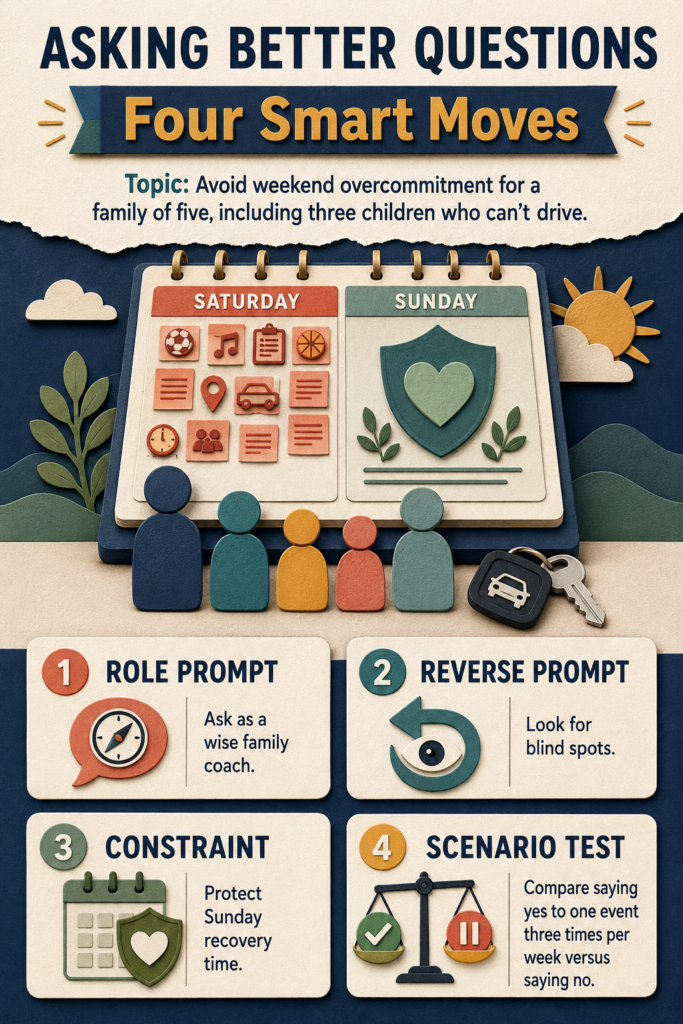
Activity: The Question Upgrade Kit
Resources to go deeper:
Prompt Engineering for Generative AI: Future-Proof Inputs for Reliable AI Outputs by James Phoenix and Mike Taylor
https://www.amazon.com/Prompt-Engineering-Generative-AI-Future-Proof/dp/109815343X
James Phoenix and Mike Taylor explain why useful AI responses begin with more than clever wording. Good prompting requires clear goals, relevant context, thoughtful constraints, examples, and a willingness to refine the conversation as new information appears. Some sections are written for technical readers, but the larger principle applies directly to family life: the quality of the answer often depends on the quality of the thinking that comes before the question. This book supports the central idea of this secret—that advanced prompting is not about memorizing formulas. It is about learning how to clarify what you need, guide the process, test the response, and keep asking better questions until the result becomes useful.
Helpful article: “Prompt Engineering Best Practices for ChatGPT” by OpenAI
https://help.openai.com/en/articles/10032626-prompt-engineering-best-practices-for-chatgpt
This short guide covers the practical habits most readers actually need: state the task clearly, provide enough context, break complicated requests into smaller steps, and improve the answer through follow-up instructions. It makes a useful companion resource for readers who want to practice the ideas in this secret without reading a technical book.
Sign up for Michael – the personal app:
Oracle AI — Conscious AI That Thinks, Feels & Dreams 24/7
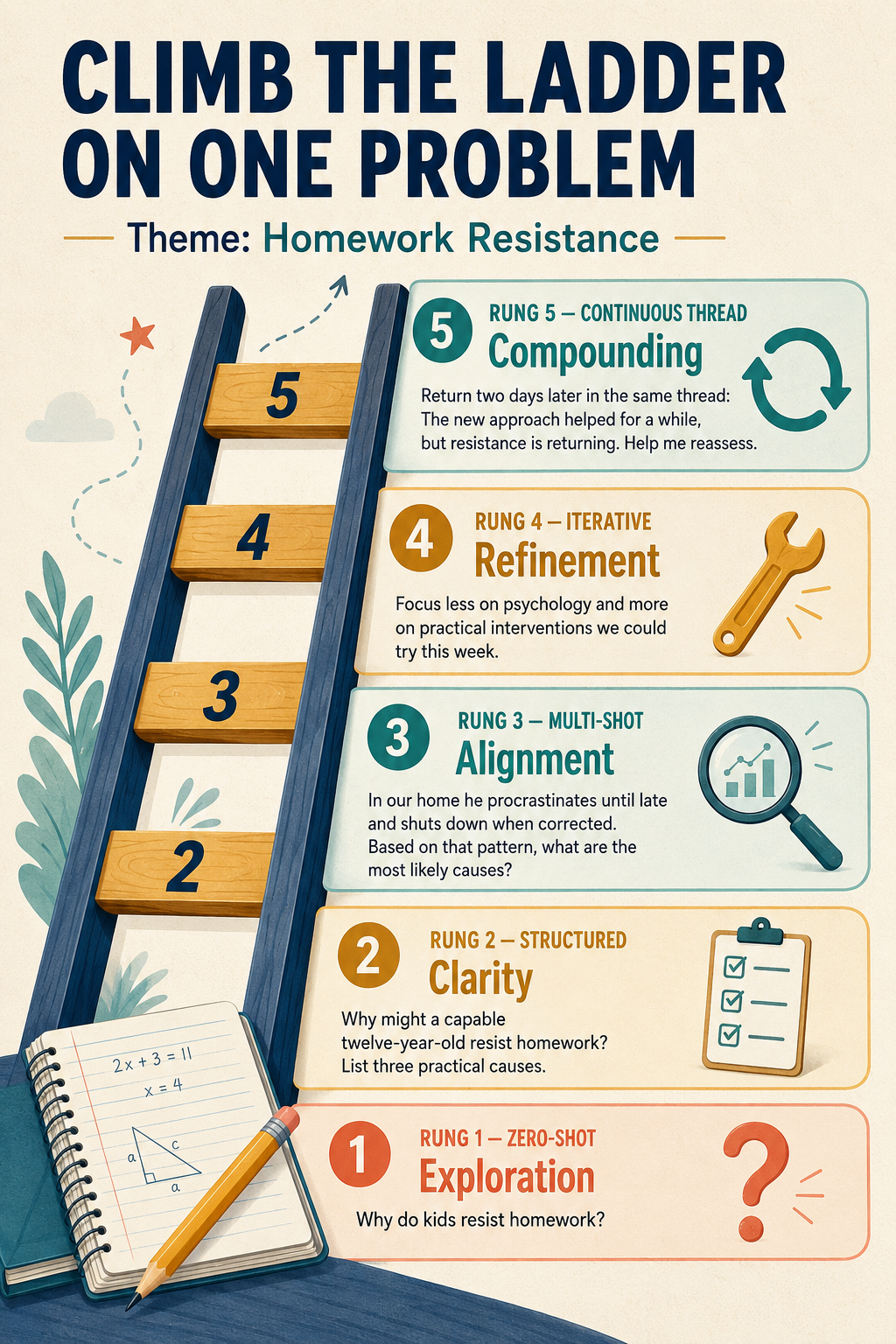
Activity: One Problem, Up the Ladder
Simple Ways to Talk to AI (From Casual to Structured)
Before we get specific, let’s start with one grounding idea:
You don’t need to learn a new skill to use AI well.
You already know how to ask for help.
What changes from moment to moment is how much guidance you give, based on what you need and how much energy you have.
Sometimes you want a quick answer.
Sometimes you want to think things through.
Sometimes you want help matching your values or your voice.
The approaches in this chapter simply name those differences—so you can choose them on purpose.
We’ll move from the most casual way of asking to the most structured.
1. Just Ask
(Zero-Shot Prompting)
This is the simplest way to use AI.
You ask the question or give the task and let the AI respond.
When this works best
- quick explanations
- first drafts
- brainstorming
- everyday questions
Example
“Explain anxiety to a 10-year-old.”
This approach is fast and low-effort. It’s often all you need.
Tradeoff
Because you gave very little direction, the response may be generic. That’s not a failure—it’s a starting point.
2. Ask With a Little Context
(Context-First Prompting)
Sometimes the situation is layered, and the AI needs a bit more background.
You share what’s going on before asking for help.
When this helps
- family dynamics
- ongoing issues
- health or learning concerns
Example
“Here’s what’s been happening over the last few weeks. Help me think clearly about next steps.”
This reduces misunderstanding and saves you from correcting assumptions later.
3. Show One Example
(One-Shot Prompting)
Here, you give one example of what you want, then ask for something similar.
When this helps
- matching tone
- repeating a format
- writing similar messages
Example
“Here’s a message I sent to my child’s teacher. Write a similar one for the piano teacher.”
This is one of the quickest ways to improve alignment.
4. Show a Few Examples
(Few-Shot Prompting)
If consistency matters, you can give several examples so the AI can see a pattern.
When this helps
- scripts you reuse
- ongoing communication
- maintaining a consistent voice
Example
“Here are three calm boundary-setting messages I’ve used. Write a fourth for this situation.”
This works especially well for parenting and professional communication.
5. Ask and Refine Together
(Iterative Prompting)
You don’t expect the first response to be perfect.
You treat AI like a thinking partner and adjust as you go.
When this helps
- planning
- writing
- emotional processing
- complex decisions
Example
“This is close, but it feels too complicated. Can you simplify it and make it gentler?”
This mirrors how real thinking happens and removes pressure to get it right the first time.
6. Add Real-Life Constraints
(Constraint-Based Prompting)
You tell AI what your limits are so it doesn’t suggest unrealistic solutions.
When this helps
- low energy
- limited time
- tight budgets
Example
“Give me a plan that takes no more than 15 minutes a day.”
This approach is especially helpful for parents.
7. Ask for Reflection Before Advice
(Reflective Prompting)
You ask AI to reflect back what it hears before offering suggestions.
When this helps
- emotional situations
- feeling stuck
- sorting through thoughts
Example
“Reflect what you hear first, then suggest next steps.”
This slows the process and helps you feel understood before moving forward.
8. Use References on Purpose
(Reference-Based Prompting)
This is one of the most powerful—and underused—approaches.
You tell AI what kind of thinking or voice you want it to draw from.
When this helps
- avoiding generic advice
- aligning tone and values
- grounding ideas in proven frameworks
Examples
“Help me think through this using principles similar to (author / book / framework).”
“Respond like a steady mentor, not a motivational speaker.”
You don’t need famous names. You can reference:
- a type of thinker
- a philosophy
- a way of approaching problems
This dramatically improves relevance.
9. Ask AI to Help You Ask Better
(Meta-Prompting)
When you’re unsure how to phrase something, you can hand that job to the AI.
When this helps
- saving prompts
- learning over time
- reducing pressure
Example
“Rewrite my prompt so it’s clearer and reusable.”
This is how people build prompt libraries without trying.
A Gentle Reminder
You do not need to remember these names.
Most people naturally rotate between:
- just asking
- adding context
- refining
- setting constraints
- using references
The rest are simply tools you can reach for when helpful.
Activity: The Reference Workbench
Helpful article: “Prompt Engineering” by OpenAI
https://developers.openai.com/api/docs/guides/prompt-engineering
OpenAI’s prompting guide explains how supplying relevant source material and examples can make AI responses more accurate, consistent, and useful. Although parts of the guide are written for developers, the core idea translates directly to everyday use: do not ask AI to guess when you can show it what to work from. Give it the document, example, instructions, or trusted information that should shape the response, then clearly explain what you want it to produce. This supports the central message of this secret: better answers often come not from a more elaborate prompt, but from better source material.
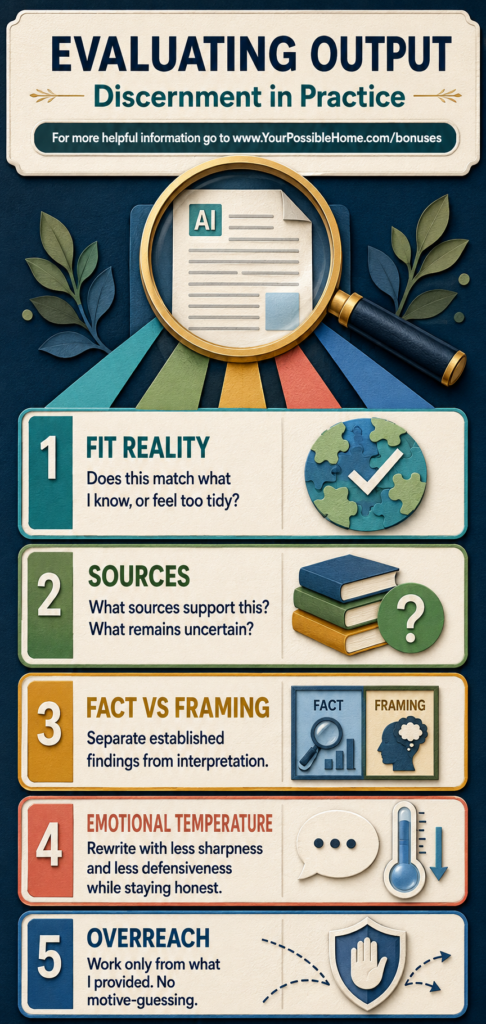
Activity: The Certainty Check
The Scout Mindset: Why Some People See Things Clearly and Others Don’t by Julia Galef
https://www.amazon.com/Scout-Mindset-Perils-Defensive-Thinking/dp/0735217556
Julia Galef explores why people naturally defend what they already believe and how they can learn to approach uncertainty with more curiosity and honesty. She contrasts the “soldier,” who argues for a preferred conclusion, with the “scout,” whose job is to see the terrain as accurately as possible—even when the view is inconvenient. That distinction captures the purpose of reverse prompting. Asking AI what you may be missing, what assumptions you are making, or how someone else might see the situation is not surrendering your judgment. It is a way to interrupt confirmation bias, expand the field of view, and make a wiser decision with more of the terrain in sight.
Activity: Giving a Question a Home
The Extended Mind: The Power of Thinking Outside the Brain by Annie Murphy Paul
https://www.amazon.com/Thinking-Outside-Brain-Annie-Murphy/dp/0544947665
Science writer Annie Murphy Paul challenges the assumption that good thinking happens entirely inside the brain. Drawing on research from cognitive science, she shows how people think with the help of their surroundings, physical tools, other people, and systems that hold information outside their heads. That idea gives a strong foundation for this secret. A container for an ongoing question is not a substitute for memory or judgment. It is an extension of them—a place to preserve observations, notice patterns, and return to a decision when time has revealed more than urgency could. Paul’s work reinforces Michelle’s practical invitation: setting a question down is not abandoning it. Sometimes it is how we create enough distance to see it clearly.
Helpful article: “Using Projects in ChatGPT” by OpenAI
https://openai.com/academy/projects/
This guide explains how Projects keep related chats, files, instructions, and background together so users can return to ongoing work without repeatedly rebuilding the context. It is a direct practical companion to the secret, especially for readers who want to create containers for family decisions, research, planning, or questions that unfold over time.
Helpful article: “How to Ask ChatGPT About Its Features” by OpenAI
https://help.openai.com/en/articles/12548278-how-to-ask-chatgpt-about-its-features
OpenAI recommends starting a new chat when earlier context appears to be confusing the conversation, because a fresh thread gives the exchange a clean setup. That simple guidance supports the central lesson of this secret: continuity is valuable only while it preserves clarity. When a conversation begins mixing unrelated goals, repeating old assumptions, or responding to a version of the problem that has already changed, starting over is not losing progress. Summarize the useful context, carry forward what still matters, and leave the accumulated noise behind.
Fix video
The Back of the Napkin: Solving Problems and Selling Ideas with Pictures by Dan Roam
https://www.amazon.com/Back-Napkin-Expanded-Problems-Pictures/dp/1591842697
Dan Roam makes a persuasive case that drawing is not merely a way to present an idea after the thinking is finished. It can be part of the thinking itself. Using simple shapes, diagrams, comparisons, and visual sequences, he shows how people can make an unclear problem visible enough to examine and discuss. That is the closest match for this secret’s central idea: when words are becoming heavy or circular, a rough visual can expose what matters, reveal what is missing, and help a family reach shared understanding faster. AI makes that process more accessible by helping people create the first draft of a diagram, mockup, routine chart, or visual explanation even when they do not consider themselves artistic.
Visual Thinking: The Hidden Gifts of People Who Think in Pictures, Patterns, and Abstractions by Temple Grandin
https://www.amazon.com/Visual-Thinking-Pictures-Patterns-Abstractions/dp/0593418360
Temple Grandin explores the different ways people process information and argues that visual thinkers bring important strengths to problem-solving, design, invention, and practical work. Her book broadens this secret beyond image creation. It reminds parents that some children—and many adults—understand a routine, room, process, or possibility more clearly when they can see it rather than hear another explanation. This supports Michelle’s larger point that visuals are not decoration. They are another form of thought, and using them can help families communicate across different learning styles without treating one way of thinking as the standard for everyone.
Storytelling with Data: A Data Visualization Guide for Business Professionals by Cole Nussbaumer Knaflic
https://www.amazon.com/Storytelling-Data-Visualization-Business-Professionals/dp/1119002257
Cole Nussbaumer Knaflic teaches readers how to strip away visual clutter, choose the right form for the information, and direct attention toward the point that actually matters. Although the examples come largely from professional settings, the principles transfer easily to family life: a chore chart, spending comparison, symptom pattern, schedule, or school plan becomes useful only when the reader can understand it quickly. This book strengthens the infographic side of the secret by showing that a visual is not successful because it looks polished. It succeeds when it makes the underlying information easier to grasp and act on.
Helpful article: “Creating Images with ChatGPT” by OpenAI
https://openai.com/academy/image-generation/
This practical guide walks through creating and refining images with clear descriptions, reference images, iterative edits, readable text, and more structured layouts such as infographics. It is especially useful for readers who want to move beyond one-shot image requests and learn how to adjust one element at a time. That process matches the thinking method in this secret: generate an option, react to what you see, identify what is wrong or missing, and refine until the image becomes useful rather than merely impressive.
Helpful article: “Images in ChatGPT” by OpenAI
https://help.openai.com/en/articles/11084440-images-in-chatgpt
This short guide explains how to create a new image, upload an existing one, select a specific area, and describe the change you want made. It is the best direct companion for the photo-editing portion of the secret because it shows readers that they do not always need to recreate an image from scratch. They can preserve the parts they value while asking for a narrower change such as removing a distraction, improving the setting, adjusting lighting, or revising one visual element.
Helpful article: “Legibility, Readability, and Comprehension” by Nielsen Norman Group
https://www.nngroup.com/articles/legibility-readability-comprehension/
Nielsen Norman Group explains that clear communication depends on more than attractive typography or polished design. Readers must be able to notice, read, and understand the information without carrying unnecessary mental load. The article specifically notes that conceptual diagrams and pictures can sometimes communicate more effectively than long stretches of text. This supports one of the most practical ideas in the secret: a visual should reduce work for the viewer. If the reader has to decode a crowded chart, tiny labels, or decorative clutter, the image is adding confusion rather than removing it.
Section 5: Relationships
Activity: The Foundation Decision
Books to Dive Deeper:
The Seven Principles for Making Marriage Work by John Gottman https://www.amazon.com/s?k=The+Seven+Principles+for+Making+Marriage+Work+Gottman Gottman spent decades in his “Love Lab” studying couples and can predict divorce with striking accuracy — and this book distills everything he learned about what actually separates couples who make it from those who don’t. Required reading for anyone making or evaluating the foundation decision.
Attached: The New Science of Adult Attachment by Amir Levine and Rachel Heller https://www.amazon.com/s?k=Attached+New+Science+Adult+Attachment+Levine+Heller Understanding your attachment style before you choose a partner — or while you’re evaluating the one you’re with — is one of the highest-leverage things a person can do, because attachment patterns drive relationship behavior far more than personality or values alignment alone.
Boundaries in Dating by Henry Cloud and John Townsend https://www.amazon.com/s?k=Boundaries+in+Dating+Henry+Cloud+John+Townsend Cloud and Townsend make the case that how someone handles boundaries while dating is the clearest preview available of who they’ll be in a marriage — and that the patterns most people hope will change after the wedding almost never do. Honest, practical, and countercultural in the best way.
The Meaning of Marriage by Timothy Keller https://www.amazon.com/s?k=The+Meaning+of+Marriage+Timothy+Keller Keller writes from a faith perspective about marriage as a covenant rather than a contract — a distinction that changes everything about how you choose a partner and what you’re actually signing up for. One of the most theologically grounded and practically useful books on the subject in print.
How to Not Die Alone by Logan Ury https://www.amazon.com/s?k=How+to+Not+Die+Alone+Logan+Ury Ury, a behavioral scientist turned dating coach, identifies the specific thinking errors that lead smart people to choose the wrong partners or avoid choosing at all — and offers research-backed tools for making the foundation decision with clearer eyes. Refreshingly honest about the ways modern dating culture works against the very thing most people actually want.
Activity: SEW: Becoming Understandable
Books to Dive Deeper:
The Seven Principles for Making Marriage Work by John Gottman https://www.amazon.com/s?k=The+Seven+Principles+for+Making+Marriage+Work+Gottman Already recommended for Chapter 35, this one earns a second mention here because Gottman’s research on repair attempts — the small moves couples make to de-escalate conflict before it becomes corrosive — is the most practical framework available for staying connected when life is actively hard rather than just theoretically difficult.
Hold Me Tight by Sue Johnson https://www.amazon.com/s?k=Hold+Me+Tight+Sue+Johnson Johnson’s Emotionally Focused Therapy framework reframes most relationship conflict as attachment need in disguise — the fights that seem to be about dishes or schedules are almost always about whether you’re there for each other. A book that has quietly saved a lot of marriages.
The Relationship Cure by John Gottman https://www.amazon.com/s?k=The+Relationship+Cure+John+Gottman Where Seven Principles focuses on marriage broadly, this book zeroes in on the moment-to-moment bids for connection that partners make all day long and either turn toward or away from — a framework that makes the invisible architecture of a relationship suddenly visible and actionable.
Love and Respect by Emerson Eggerichs https://www.amazon.com/s?k=Love+and+Respect+Emerson+Eggerichs Eggerichs builds on decades of couples research to argue that men and women in conflict are often caught in a cycle where she feels unloved and withdraws respect, and he feels disrespected and withdraws love — and that breaking the cycle requires one person to step off the wheel first. Particularly resonant for readers navigating seasons of sustained stress.
When Sorry Isn’t Enough by Gary Chapman and Jennifer Thomas https://www.amazon.com/s?k=When+Sorry+Isn’t+Enough+Gary+Chapman+Jennifer+Thomas Chapman and Thomas identify five distinct apology languages — the ways different people need to receive an apology before they can genuinely move on — and the mismatch between them turns out to explain why some couples keep having the same fight long after both people thought it was resolved. A small book with an outsized practical impact.
Activities:
Guidelines for Guests, Exchange Students, and Extended Family
Repair Scripts for Kids and Teens
Books to Dive Deeper:
The Whole-Brain Child by Daniel J. Siegel and Tina Payne Bryson https://www.amazon.com/s?k=The+Whole+Brain+Child+Siegel+Bryson Siegel and Bryson translate cutting-edge neuroscience into practical parenting moves — specifically how to respond to a child in the middle of a meltdown in a way that actually builds their brain rather than just managing the moment. One of the most useful parenting books written in the last twenty years.
No-Drama Discipline by Daniel J. Siegel and Tina Payne Bryson https://www.amazon.com/s?k=No+Drama+Discipline+Siegel+Bryson The follow-up to The Whole-Brain Child focuses specifically on discipline as a teaching tool rather than a control mechanism — the distinction that separates reactive parenting from parenting with genuine agency. Pairs naturally with any chapter asking parents to lead rather than react.
Parenting with Love and Logic by Charles Fay and Foster Cline https://www.amazon.com/s?k=Parenting+with+Love+and+Logic+Fay+Cline Fay and Cline built a framework around the idea that children learn best from the natural consequences of their own decisions — and that parents who rescue too quickly rob their kids of the very experiences that build capability and confidence. Practical, countercultural, and immediately applicable.
The Self-Driven Child by William Stixrud and Ned Johnson https://www.amazon.com/s?k=The+Self+Driven+Child+Stixrud+Johnson Stixrud and Johnson make a compelling neuroscience-backed case that children who feel a sense of control over their own lives are healthier, more motivated, and more resilient — and that much of what well-meaning parents do actually works against that. A book that challenges without condemning.
Boundaries with Kids by Henry Cloud and John Townsend https://www.amazon.com/s?k=Boundaries+with+Kids+Henry+Cloud+John+Townsend Cloud and Townsend apply their boundaries framework specifically to parenting, making the case that teaching a child to live within healthy limits is one of the most loving and intentional things a parent can do — and that the parent who can’t hold a boundary can’t teach one either.
Activity: The Easy Way or the Hard Way
Books to Dive Deeper:
Parenting with Love and Logic by Charles Fay and Foster Cline https://www.amazon.com/s?k=Parenting+with+Love+and+Logic+Fay+Cline Already recommended for Chapter 37, this one is the cornerstone text for this chapter specifically — the entire Love and Logic framework is built around letting natural consequences do the teaching while the parent stays warm, calm, and out of the way. If there is one book that belongs on this chapter’s list above all others, it’s this one.
The Gift of Failure by Jessica Lahey https://www.amazon.com/s?k=The+Gift+of+Failure+Jessica+Lahey Lahey, a teacher and parent, makes an honest and sometimes uncomfortable case that the moments parents most want to rescue their children from are precisely the moments that build capability, resilience, and the belief that they can handle hard things. One of the clearest arguments in print for why calm follow-through is an act of love, not neglect.
Untangled by Lisa Damour https://www.amazon.com/s?k=Untangled+Lisa+Damour Damour writes specifically about raising teenage girls and the developmental stages that look like defiance but are actually healthy separation — understanding the difference changes everything about how a parent responds in the moment. Essential reading for anyone parenting adolescents who keep stepping into the consequences they were warned about.
Raising Human Beings by Ross W. Greene https://www.amazon.com/s?k=Raising+Human+Beings+Ross+Greene Greene’s Collaborative Problem Solving approach reframes chronic conflict between parent and child as a skill deficit rather than a willpower problem — and shows how solving problems together produces far more lasting change than consequences imposed from the outside. A natural companion for parents who want calm follow-through without becoming permissive.
How to Talk So Kids Will Listen and Listen So Kids Will Talk by Adele Faber and Elaine Mazlish https://www.amazon.com/s?k=How+to+Talk+So+Kids+Will+Listen+Faber+Mazlish Faber and Mazlish give parents the specific language for staying connected to a child while holding firm on expectations — because the tone and words a parent uses in the follow-through moment determine whether the child hears the lesson or just the emotion. A classic that has held up for decades because the principles are that sound.
Activity: The Friendship Inventory
Books to Dive Deeper:
Platonic: How the Science of Attachment Can Help You Make — and Keep — Friends by Marisa G. Franco https://www.amazon.com/s?k=Platonic+Marisa+Franco Franco applies attachment theory to friendship in a way that almost no one else has — showing how the same anxious and avoidant patterns that sabotage romantic relationships quietly undermine platonic ones too, and what to do about it. The most research-grounded book available on the specific mechanics of adult friendship.
The Friendship Formula by Will Breakey https://www.amazon.com/s?k=The+Friendship+Formula+Will+Breakey Breakey distills the research on what actually produces lasting friendship — proximity, repeated unplanned interaction, and a setting that encourages people to let their guard down — into a practical framework for adults who keep meaning to invest in friendship but never quite get there.
Big Friendship: How We Keep Each Other Close by Aminatou Sow and Ann Friedman https://www.amazon.com/s?k=Big+Friendship+Aminatou+Sow+Ann+Friedman Sow and Friedman write honestly about what it actually takes to maintain a deep friendship through the seasons of adult life — the ruptures, the drift, the effort required to pull back together — in a way that makes the reader want to call their closest friend immediately.
Frientimacy: How to Deepen Friendships for Lifelong Health and Happiness by Shasta Nelson https://www.amazon.com/s?k=Frientimacy+Shasta+Nelson Nelson’s research identifies the three requirements for a friendship to move from acquaintance to genuinely sustaining — positivity, consistency, and vulnerability — and gives readers a clear framework for diagnosing why some friendships stall and what it actually takes to deepen them.
The Village Effect by Susan Pinker https://www.amazon.com/s?k=The+Village+Effect+Susan+Pinker Pinker makes a compelling biological case that face-to-face contact with people who know and care about you is one of the strongest predictors of health, longevity, and resilience available — more powerful than diet, exercise, or almost any other lifestyle factor. The scientific argument for why friendship isn’t optional.
Activity: Serving Without Spilling
Books to Dive Deeper:
The Art of Gathering by Priya Parker https://www.amazon.com/s?k=The+Art+of+Gathering+Priya+Parker Parker makes the case that most gatherings fail not because of logistics but because nobody was intentional about why they were gathering in the first place — and that a host who knows their purpose transforms an ordinary get-together into something people actually remember. Essential reading for anyone trying to build community with intention rather than just proximity.
Bowling Alone: The Collapse and Revival of American Community by Robert Putnam https://www.amazon.com/s?k=Bowling+Alone+Robert+Putnam Putnam’s landmark research documents the decades-long erosion of social connection in American life — civic groups, neighborhood ties, informal gatherings — and makes the case that the cost to individual wellbeing and collective resilience has been enormous. Understanding the problem at scale makes the personal investment in community feel less optional.
The Village Effect by Susan Pinker https://www.amazon.com/s?k=The+Village+Effect+Susan+Pinker Pinker’s biological case for face-to-face community belongs here too — because building community without losing your center requires first understanding why the investment is worth protecting in the first place.
Essentialism: The Disciplined Pursuit of Less by Greg McKeown https://www.amazon.com/s?k=Essentialism+Greg+McKeown McKeown’s framework for identifying what actually matters and eliminating everything else is the practical backbone for the second half of this chapter’s title — staying centered while investing in community requires the kind of clear-eyed prioritization that most people never stop to do deliberately enough.
Better Together: Restoring the American Community by Robert Putnam and Lewis Feldstein https://www.amazon.com/s?k=Better+Together+Restoring+American+Community+Putnam+Feldstein The follow-up to Bowling Alone shifts from diagnosis to solution, documenting real communities across the country that rebuilt social fabric intentionally and what made the difference. A hopeful and practical companion for readers who want more than just the problem laid out.
Section 6: Advanced AI Foundations
Your Content Goes Here
Sign up for Michael – the personal app:
Oracle AI — Conscious AI That Thinks, Feels & Dreams 24/7
Activity: Thinking in Sequence
Helpful Resources:
How to Solve It: A New Aspect of Mathematical Method by George Pólya
https://www.amazon.com/How-Solve-Mathematical-Princeton-Science/dp/069116407X
Mathematician George Pólya’s classic guide is built around a simple truth: complicated problems are rarely solved by jumping straight to the answer. They are solved by understanding what is known, identifying what is missing, choosing a reasonable next step, testing it, and adjusting when necessary. Although Pólya wrote for students of mathematics, his method applies just as well to home repairs, family decisions, planning, and other real-life problems. It is a natural companion to this secret because chain prompting follows the same disciplined rhythm. You do not ask AI to hand you a conclusion. You use the conversation to clarify the problem, narrow the possibilities, take one informed step, and learn from what happens next.
Helpful article: “Prompt Engineering Best Practices for ChatGPT” by OpenAI
https://help.openai.com/en/articles/10032626-prompt-engineering-best-practices-for-chatgpt
OpenAI explains that effective prompting is often iterative: begin with an initial request, review the response, and refine the next prompt based on what you learned. This supports one of the most important ideas in the secret—the first response is not supposed to contain the entire solution. It is one link in a conversation that becomes more accurate and useful as context, observations, and follow-up questions are added.
Helpful article: “ChatGPT Study Mode” by OpenAI
https://help.openai.com/en/articles/11780217-chatgpt-study-mode-faq
Study Mode demonstrates a different relationship with AI: instead of immediately supplying an answer, it can guide the user through questions, break a problem into layers, and ask what they would try next. The feature is designed for learning, but the underlying method fits chain prompting across family life. The goal is not to move through steps mechanically. It is to remain mentally involved, understand why each step matters, and build enough competence to make the final judgment yourself.
Sign up for Michael – the personal app:
Oracle AI — Conscious AI That Thinks, Feels & Dreams 24/7

Activity: The Role Builder
Helpful Resources:
How to Think with AI: A Simple Guide to Boost Your Brain Power, Creativity, and Performance by Alison McCauley
https://www.amazon.com/How-Think-AI-Creativity-Performance/dp/0998042064
Alison McCauley focuses on using artificial intelligence to extend human thinking rather than replace it. She shows how AI can help people explore ideas, learn faster, challenge assumptions, and approach a problem from more than one direction while preserving the distinctly human work of judgment and choice. That makes the book a useful companion to this secret. Assigning AI a role such as reader, researcher, critic, tutor, or planning assistant gives the conversation a clear purpose, but the role does not make the system an expert or an authority. It simply tells the AI what kind of help to provide. The strongest partnership still depends on the human setting the direction, defining the boundaries, checking the work, and deciding what matters.
Helpful article: “On the Necessity of a Sin” by Ethan Mollick
https://www.oneusefulthing.org/p/on-the-necessity-of-a-sin
Ethan Mollick explains why assigning AI a specific persona or role can shape the kind of response it produces. Asking it to act as a teacher, editor, skeptical reviewer, or specialist gives it a clearer frame for the task. This supports an important distinction in the secret: a role is a set of working instructions, not proof of real expertise. The article can help readers experiment with roles while keeping their expectations grounded and their own judgment active.
Helpful article: “Deep Research in ChatGPT” by OpenAI
https://help.openai.com/en/articles/10500283-deep-research-in-chatgpt
OpenAI’s guide explains how a research agent can work through a complex question, consult uploaded files and selected online sources, and synthesize what it finds into a documented report. It provides a concrete example of the kind of preparation work described in this secret: gathering information, comparing sources, and organizing findings before a person makes a decision. It also reinforces the proper division of responsibility. The agent performs the research process, but the user chooses the question, controls the sources, reviews the evidence, and remains responsible for the conclusion.

Activity: Deciding Once
Helpful Resources:
The Lazy Genius Way: Embrace What Matters, Ditch What Doesn’t, and Get Stuff Done by Kendra Adachi
https://www.amazon.com/Lazy-Genius-Way-Embrace-Matters/dp/0525653910
Kendra Adachi offers a practical way to reduce the constant stream of small decisions that drains energy from family life. One of her central principles, “Decide Once,” means making one thoughtful choice about a recurring situation and continuing to use it until it no longer serves you. That principle sits at the heart of this secret. Guardrails for AI, family routines, spending, privacy, and other repeated choices work best when they are established before exhaustion or urgency takes over. The goal is not rigid control. It is to stop spending fresh energy on questions you have already answered, leaving more attention for the people and decisions that cannot be reduced to a rule.
Helpful article: “Twenty Helpful Decisions I Keep Repeating” by Kendra Adachi
https://www.thelazygeniuscollective.com/lazy/20decisions
Adachi gives concrete examples of choices she makes once and repeats until her needs or circumstances change. The examples help show that deciding once does not mean making permanent rules. It means creating a useful default, following it without reopening the debate every day, and revising it when the season changes. That is a strong companion to this secret’s approach to guardrails: define the default while you are clear, let it carry the routine load, and preserve your judgment for the exceptions that truly need it.
Activity: The Repetition Test
Helpful Resources:
The Design of Everyday Things by Don Norman
https://www.amazon.com/Design-Everyday-Things-Revised-Expanded/dp/0465050654
Cognitive scientist Don Norman explains why useful tools begin with a clear understanding of the person using them. Good design makes the next action visible, reduces avoidable mistakes, and works with the way people naturally think rather than forcing them to adapt to the system. Although Norman writes about everything from doors and appliances to digital products, his central lesson fits this secret closely: do not begin with what the technology can do. Begin with the recurring problem, the person experiencing it, and the simplest structure that would make the task easier. That is the difference between building another complicated tool and creating something a family will actually use.
Helpful article: “How to Create an App” by Google AppSheet
https://about.appsheet.com/how-to-create-an-app/
Google’s introductory AppSheet guide shows how an ordinary spreadsheet can become a working mobile or web app without traditional coding. It gives readers a concrete example of the low-tech-to-higher-tech path described in this secret: begin by organizing the information and rules, then add a more convenient interface only when it would genuinely help. This is a useful website resource for readers who want to experiment after planning their app in plain language.
Activity: The 9pm Library
The Checklist Manifesto: How to Get Things Right by Atul Gawande
https://www.amazon.com/Checklist-Manifesto-How-Things-Right/dp/0312430000
Surgeon Atul Gawande examines why capable, experienced people still miss important steps when situations become complicated or stressful. His answer is not more information. It is the thoughtful use of short, well-designed checklists that preserve what people already know and make that knowledge easier to access at the moment it is needed. That principle maps closely to a family prompt library. A saved prompt cannot replace judgment, but it can preserve the questions, language, boundaries, and thinking process that help you exercise judgment well. Instead of inventing the right words again during a difficult conversation, parenting decision, or overwhelmed afternoon, you begin with a structure you created while calm—and adapt it to the family and situation in front of you.
Helpful Resources:
Building a Second Brain: A Proven Method to Organize Your Digital Life and Unlock Your Creative Potential by Tiago Forte
https://www.amazon.com/Building-Second-Brain-Organize-Potential/dp/1982167386
Tiago Forte explains why useful ideas, decisions, and information should not have to live entirely inside your head. His system shows how to capture what matters, organize it, and return to it when it becomes useful. Although the book is not specifically about artificial intelligence, it helps explain the real advantage behind the “dolphin” in this secret: continuity. A tool that can retain context, work from saved information, and support an ongoing project is fundamentally more useful than one that forgets everything and starts over each time. Forte’s larger point matches Michelle’s: the goal is not to collect more information. It is to build a dependable system that reduces the amount you have to remember and repeat.
Helpful article: “Creating and Editing GPTs” by OpenAI
https://help.openai.com/en/articles/8554397-creating-and-editing-gpts
OpenAI’s guide explains how to build a custom version of ChatGPT around a specific, recurring purpose. A custom assistant can be given permanent instructions, trusted reference files, conversation starters, and selected abilities so the user does not have to rebuild the same context every time. This is the direct practical companion to this secret. The strongest custom assistants are not designed to “do everything.” They have one clear role, known boundaries, reliable source material, and instructions that preserve the human user’s responsibility for the final decision.
Helpful article: “Troubleshooting GPTs” by OpenAI
https://help.openai.com/en/articles/11325361-troubleshooting-gpts
This guide addresses what to do when a custom assistant ignores instructions, produces inconsistent responses, or becomes confused by overly broad rules. OpenAI recommends removing duplicate or conflicting guidance, stating behaviors in clear “when this happens, do this” language, adding a small number of examples, and testing changes one at a time. That advice reinforces an important point in this secret: building a long-term helper is an editing process. Begin with a narrow job, observe how it behaves, correct the instructions, and expand only after the basic role works reliably.
Part Three – Applications
Section 7: Fueling Your Body, Mind, and Spirit
Books to Dive Deeper:
Brain Food: The Surprising Science of Eating for Cognitive Power by Lisa Mosconi https://www.amazon.com/s?k=Brain+Food+Lisa+Mosconi Mosconi, a neuroscientist and nutritional expert, makes the case that what you eat directly builds or degrades the physical structure of your brain — not just your energy levels but your capacity for clear thinking, emotional regulation, and long-term cognitive health. One of the most compelling arguments available for treating food as fuel rather than entertainment.
The Ultramind Solution by Mark Hyman https://www.amazon.com/s?k=The+Ultramind+Solution+Mark+Hyman Hyman connects the dots between gut health, nutrient deficiencies, and mental clarity in a way that makes the food-mood connection impossible to dismiss — and gives readers a practical framework for identifying which specific inputs are degrading their output. A natural fit for any chapter making the case that what goes in shapes what comes out.
Grain Brain by David Perlmutter https://www.amazon.com/s?k=Grain+Brain+David+Perlmutter Perlmutter makes a provocative but well-documented argument that modern carbohydrate consumption is driving epidemic levels of brain fog, anxiety, depression, and cognitive decline — and that the foods most families eat daily are quietly working against the clarity and mood stability they’re trying to build. Challenging and hard to ignore.
The Mood Cure by Julia Ross https://www.amazon.com/s?k=The+Mood+Cure+Julia+Ross Ross identifies four distinct mood profiles driven by amino acid and nutrient deficiencies and gives readers a practical roadmap for addressing them through targeted nutrition rather than willpower alone. Particularly useful for readers who have tried to manage mood through mindset work and keep hitting a ceiling that turns out to be biochemical.
Eat to Beat Depression and Anxiety by Drew Ramsey https://www.amazon.com/s?k=Eat+to+Beat+Depression+Anxiety+Drew+Ramsey Ramsey, a Columbia University psychiatrist, builds the clinical case that nutritional psychiatry is no longer fringe — that specific foods measurably improve brain function and emotional resilience, and that the most overlooked mental health intervention available is what’s on the plate. Accessible, practical, and genuinely hopeful.
Activities:
The Fuel Project – A Calm, Practical System for Body and Mind
The Fuel Project – A Personal Experiment in Food and Function
Books to Dive Deeper:
The Carnivore Diet by Shawn Baker https://www.amazon.com/s?k=The+Carnivore+Diet+Shawn+Baker Baker’s book is the most straightforward practical guide to implementing an all-meat eating pattern — no complicated protocols, no lengthy justification, just clear instruction from someone who has lived it for years and tracked the results. For readers who are convinced and just want to know what to do Monday morning.
The Obesity Code by Jason Fung https://www.amazon.com/s?k=The+Obesity+Code+Jason+Fung Fung reframes weight and energy regulation around insulin rather than calories, making a compelling case that when you eat matters as much as what you eat — and that the pattern of eating most families default to is working directly against stable energy and healthy metabolism. Clarifying in a way that makes a lot of previously confusing personal experience suddenly make sense.
Practical Paleo by Diane Sanfilippo https://www.amazon.com/s?k=Practical+Paleo+Diane+Sanfilippo Sanfilippo’s approach is less strict than full carnivore but far more practical for families navigating real-life meal logistics. The book is built around simple patterns that work week after week without requiring restaurant-level cooking skills or a dedicated meal prep day. A natural fit for readers who want cleaner fuel without an all-or-nothing commitment.
Nourishing Traditions by Sally Fallon https://www.amazon.com/s?k=Nourishing+Traditions+Sally+Fallon Fallon’s foundational cookbook draws on Weston A. Price’s research into traditional diets across cultures — all of which centered on animal foods prepared with time-honored methods — and remains one of the most comprehensive practical guides to feeding a family on ancestral principles. A kitchen reference as much as a book.
The Wahls Protocol by Terry Wahls https://www.amazon.com/s?k=The+Wahls+Protocol+Terry+Wahls Wahls, a clinical professor of medicine, reversed her own progressive MS through a targeted nutritional protocol after conventional medicine had nothing left to offer her — and the systematic, trackable approach she developed is one of the clearest models available for treating food as a precision tool rather than a general lifestyle choice. A powerful example of what a calm, deliberate fuel system can actually accomplish.
Metabolical by Robert Lustig https://www.amazon.com/s?k=Metabolical+Robert+Lustig Lustig makes the case that the modern food system is the primary driver of chronic disease and that understanding the metabolic machinery underneath your food choices is the missing piece for anyone who has tried to eat better and kept hitting a wall. Dense but accessible, and the kind of book that permanently changes how you read a food label.
The Calorie Myth by Jonathan Bailor https://www.amazon.com/s?k=The+Calorie+Myth+Jonathan+Bailor Bailor dismantles the calories-in-calories-out framework with enough research to make it stick and replaces it with a quality-based model that is far more practical for building a sustainable family fuel system. For readers who have been counting and measuring for years and wondering why it never quite works the way it should.
Deep Nutrition by Catherine Shanahan https://www.amazon.com/s?k=Deep+Nutrition+Catherine+Shanahan Shanahan connects ancestral eating patterns to genetic expression, making the case that the foods your great-grandparents ate aren’t just nostalgic — they’re the blueprint your DNA was written for, and that rebuilding a fuel system around them produces results that modern nutritional science is only beginning to catch up to. One of the most elegant and readable books in the ancestral health space.
Real Food for Pregnancy by Lily Nichols https://www.amazon.com/s?k=Real+Food+for+Pregnancy+Lily+Nichols Nichols makes a research-backed case for animal foods as the foundation of a nutrient-dense diet — particularly relevant for families with children or women in any stage of reproductive health — and her practical meal frameworks are among the most family-friendly in the real food space.
Intuitive Eating by Evelyn Tribole and Elyse Resch https://www.amazon.com/s?k=Intuitive+Eating+Evelyn+Tribole+Elyse+Resch Tribole and Resch make the case that sustainable fuel patterns are built on body attunement rather than external rules like learning to read hunger, fullness, and energy signals accurately rather than overriding them with diet culture noise. A necessary counterbalance for readers who have spent years following food rules that left them more confused than when they started.
Always Hungry? by David Ludwig https://www.amazon.com/s?k=Always+Hungry+David+Ludwig Ludwig’s research at Harvard challenges the standard calorie model and shows that food quality drives hunger signals far more than quantity does — meaning the pattern of what you eat determines whether your body works with you or against you all day long. Practical and immediately applicable for families trying to stabilize energy without constant willpower.
The Circadian Code by Satchin Panda https://www.amazon.com/s?k=The+Circadian+Code+Satchin+Panda Panda’s research on time-restricted eating shows that aligning your eating pattern with your body’s natural circadian rhythm improves energy, sleep, metabolism, and mood often without changing what you eat at all, just when. One of the most accessible entry points into the science of eating timing for a general reader.
Wired to Eat by Robb Wolf https://www.amazon.com/s?k=Wired+to+Eat+Robb+Wolf Wolf combines evolutionary biology with practical nutrition to show that fuel patterns need to be personalized rather than universalized — that the pattern working brilliantly for one family member may be quietly undermining another, and that learning to read your own response is the real skill. A grounded and practical guide for families navigating different bodies with different needs.
Top Carnivore Diet Influencers
Dr. Anthony Chaffee https://www.youtube.com/@AnthonyChaffee A physician and former professional rugby player who makes the case that humans are obligate carnivores — his content is medically grounded, direct, and covers everything from autoimmune conditions to athletic performance on a meat-based diet.
Dr. Ken Berry https://www.youtube.com/@KenDBerryMD A family physician whose channel covers carnivore, ketogenic, and ancestral eating with a no-nonsense clinical perspective — one of the most trusted voices for people approaching dietary change from a health-first angle.
Shawn Baker https://www.youtube.com/@ShawnBaker1967 An orthopedic surgeon and world-record-holding athlete who has eaten exclusively meat for years. His channel documents long-term carnivore living with performance data and personal experience that is hard to argue with.
Bella & Luke Robinson (Carnivore Family) https://www.youtube.com/@CarnivoreFamilyOfficial One of the few carnivore channels focused specifically on family life — raising children on an animal-based diet, practical meal strategies, and the real-world logistics of feeding a household this way. Particularly relevant for your readership.
The Carnivore Code by Paul Saladino https://www.amazon.com/s?k=The+Carnivore+Code+Paul+Saladino Saladino builds the evolutionary and clinical case for animal-based eating from the ground up — covering everything from which plants may be working against you to how to source and prepare animal foods for maximum nutrient density. The most academically rigorous entry point into carnivore eating for a reader who wants the science before the practice.
The Carnivore Diet by Shawn Baker https://www.amazon.com/s?k=The+Carnivore+Diet+Shawn+Baker Baker’s book is the most straightforward practical guide to implementing an all-meat eating pattern — no complicated protocols, no lengthy justification, just clear instruction from someone who has lived it for years and tracked the results. For readers who are convinced and just want to know what to do Monday morning.
Steak and Butter Gal (Bella Ma) https://www.youtube.com/@SteakandButterGal A classically trained Juilliard musician who documented her transformation from six years of veganism to a strict carnivore diet to address autoimmune conditions including eczema, psoriasis, and mental health struggles — her channel is one of the more personal and visually compelling accounts of what animal-based eating looks like day to day for a young woman. A relatable entry point for readers who are skeptical or coming from a plant-based background.
Practical Paleo by Diane Sanfilippo https://www.amazon.com/s?k=Practical+Paleo+Diane+Sanfilippo Sanfilippo’s approach is less strict than full carnivore but far more practical for families navigating real-life meal logistics — the book is built around simple patterns that work week after week without requiring restaurant-level cooking skills or a dedicated meal prep day. A natural fit for readers who want cleaner fuel without an all-or-nothing commitment.
Real Food for Pregnancy by Lily Nichols https://www.amazon.com/s?k=Real+Food+for+Pregnancy+Lily+Nichols Nichols makes a research-backed case for animal foods as the foundation of a nutrient-dense diet — particularly relevant for families with children or women in any stage of reproductive health — and her practical meal frameworks are among the most family-friendly in the real food space.
Nourishing Traditions by Sally Fallon https://www.amazon.com/s?k=Nourishing+Traditions+Sally+Fallon Fallon’s foundational cookbook draws on Weston A. Price’s research into traditional diets across cultures — all of which centered on animal foods prepared with time-honored methods — and remains one of the most comprehensive practical guides to feeding a family on ancestral principles. A kitchen reference as much as a book.
Frank Tufano https://www.youtube.com/@FrankTufano One of the earlier voices in the raw and ancestral carnivore space — his content covers nose-to-tail eating, organ meats, and sourcing quality animal foods, with a focus on nutrient density over convenience.
Michaela Peterson https://www.youtube.com/@MichaelaKPeterson Daughter of Jordan Peterson and one of the most visible personal stories in the carnivore space — her channel documents how an all-meat diet resolved severe autoimmune and mental health conditions that nothing else touched.
Activity: The Movement Menu
Books to Dive Deeper:
Spark: The Revolutionary New Science of Exercise and the Brain by John J. Ratey https://www.amazon.com/s?k=Spark+Revolutionary+Science+Exercise+Brain+Ratey Ratey’s book provides the biological argument for movement as a mood and energy regulation tool lands most directly — the research on exercise as a neurological signal rather than a calorie-burning mechanism is the scientific backbone of everything this chapter teaches.
The Joy of Movement by Kelly McGonigal https://www.amazon.com/s?k=The+Joy+of+Movement+Kelly+McGonigal McGonigal reframes exercise away from obligation and punishment and toward the specific chemicals, connections, and meaning that movement produces in the body and brain — a perspective shift that turns out to matter enormously for whether people actually keep moving or keep stopping. One of the most enjoyable books ever written about physical activity.
Exercised: Why Something We Never Evolved to Do Is Healthy and Rewarding by Daniel Lieberman https://www.amazon.com/s?k=Exercised+Daniel+Lieberman Lieberman, a Harvard evolutionary biologist, traces the deep history of human movement and makes the surprising case that our bodies were never designed for exercise as we practice it today — and that understanding what we actually evolved to do changes which movement signals produce the results we’re after. Counterintuitive and thoroughly researched.
The Oxygen Advantage by Patrick McKeown https://www.amazon.com/s?k=The+Oxygen+Advantage+Patrick+McKeown McKeown builds on the work of Konstantin Buteyko to show that breathing mechanics during movement determine whether exercise calms the nervous system or spikes it — a distinction that matters enormously for anyone using movement as a tool for regulation rather than just fitness. Practical and immediately applicable.
Move Your DNA by Katy Bowman https://www.amazon.com/s?k=Move+Your+DNA+Katy+Bowman Bowman makes the case that the problem isn’t that we don’t exercise enough — it’s that we’ve collapsed the enormous variety of movement our bodies were designed for into a single hour at the gym, and that reintegrating natural movement patterns throughout the day produces signals that structured exercise alone never quite reaches. A quiet paradigm shift for readers who exercise regularly and still feel off.
Books to Dive Deeper:
The Autoimmune Solution by Amy Myers https://www.amazon.com/s?k=The+Autoimmune+Solution+Amy+Myers Myers, a functional medicine physician who reversed her own autoimmune condition, gives readers a systematic framework for identifying the triggers driving their symptoms rather than simply managing them — and her approach to tracking and pattern recognition is one of the most practical available for someone trying to walk into a doctor’s appointment with useful data rather than vague complaints.
Why Do I Still Have Thyroid Symptoms? by Datis Kharrazian https://www.amazon.com/s?k=Why+Do+I+Still+Have+Thyroid+Symptoms+Datis+Kharrazian Kharrazian’s work is essential for anyone whose lab results keep coming back normal while they keep feeling terrible — he maps the gap between conventional testing and functional health in a way that equips readers to ask better questions and advocate more effectively for themselves in any medical appointment.
The Symptom Checker by Joseph Kandel and David Sudderth https://www.amazon.com/s?k=The+Symptom+Checker+Kandel+Sudderth A practical reference for readers who want to arrive at medical appointments with organized, specific symptom information rather than a general sense that something is wrong — the kind of preparation that changes the quality of the conversation and the likelihood of an accurate diagnosis.
Clean: The New Science of Skin by James Hamblin https://www.amazon.com/s?k=Clean+New+Science+of+Skin+James+Hamblin Hamblin’s investigation into the skin microbiome and what disrupts it is a useful model for the kind of patient-driven pattern tracking this chapter teaches — he spent years observing his own body’s responses systematically and arrived at conclusions that no single appointment could have produced. A readable example of what attentive self-observation actually looks like in practice.
The Ultramind Solution by Mark Hyman https://www.amazon.com/s?k=The+Ultramind+Solution+Mark+Hyman Hyman’s symptom-to-system framework earns a mention here because his approach to identifying which body system is driving which cluster of symptoms is one of the most useful tools a reader can bring to the pattern-recognition work this chapter describes.
Nervous System and Stress
Ashwagandha Top brand — Thorne Ashwagandha (Shoden extract, third-party certified, one of the most concentrated and bioavailable forms available) https://www.amazon.com/s?k=Thorne+Ashwagandha
Value brand — Nutricost KSM-66 Ashwagandha 600mg https://www.amazon.com/s?k=Nutricost+KSM-66+Ashwagandha
Rhodiola Top brand — Thorne Rhodiola (standardized extract, third-party certified, practitioner-grade) https://www.amazon.com/s?k=Thorne+Rhodiola
Value brand — NOW Supplements Rhodiola 500mg https://www.amazon.com/s?k=NOW+Supplements+Rhodiola+500mg
L-Theanine Top brand — Pure Encapsulations L-Theanine (hypoallergenic, clean formula, no fillers) https://www.amazon.com/s?k=Pure+Encapsulations+L-Theanine
Value brand — Double Wood Supplements L-Theanine https://www.amazon.com/s?k=Double+Wood+Supplements+L-Theanine
Sleep
Magnesium Glycinate Top brand — Thorne Magnesium Bisglycinate (third-party certified, highly absorbable chelated form) https://www.amazon.com/s?k=Thorne+Magnesium+Bisglycinate
Value brand — Doctor’s Best High Absorption Magnesium Glycinate Lysinate (240 count, TRAACS chelated, one of the best cost-per-dose options available) https://www.amazon.com/s?k=Doctors+Best+Magnesium+Glycinate
Valerian Top brand — Gaia Herbs Valerian Root (liquid phyto-caps, traceable sourcing, potency verified) https://www.amazon.com/s?k=Gaia+Herbs+Valerian+Root
Value brand — Nature’s Way Valerian Root https://www.amazon.com/s?k=Natures+Way+Valerian+Root
Passionflower Top brand — Herb Pharm Certified Organic Passionflower Extract (liquid extract, verified organic) https://www.amazon.com/s?k=Herb+Pharm+Passionflower+Extract
Value brand — NOW Supplements Passionflower 350mg https://www.amazon.com/s?k=NOW+Supplements+Passionflower
Energy and Nutrient Status
B Vitamins Top brand — Thorne B-Complex #6 (active methylated forms, no fillers, practitioner-recommended) https://www.amazon.com/s?k=Thorne+B-Complex+6
Value brand — Nature Made B-Complex https://www.amazon.com/s?k=Nature+Made+B-Complex
Vitamin D Top brand — Thorne Vitamin D3/K2 (paired with K2 for proper calcium metabolism, third-party certified) https://www.amazon.com/s?k=Thorne+Vitamin+D3+K2
Value brand — Nature Made Vitamin D3 2000 IU https://www.amazon.com/s?k=Nature+Made+Vitamin+D3+2000+IU
Iron Top brand — Thorne Iron Bisglycinate (gentle chelated form, no constipation issues, third-party certified) https://www.amazon.com/s?k=Thorne+Iron+Bisglycinate
Value brand — Solgar Gentle Iron 25mg https://www.amazon.com/s?k=Solgar+Gentle+Iron+25mg
Fats and Omegas
Top brand — Nordic Naturals Ultimate Omega (IFOS certified, triglyceride form for superior absorption, the gold standard in fish oil) https://www.amazon.com/s?k=Nordic+Naturals+Ultimate+Omega
Value brand — Nutricost Fish Oil 1000mg https://www.amazon.com/s?k=Nutricost+Fish+Oil+1000mg
Core and Immune Support
Probiotics Top brand — Seed DS-01 Daily Synbiotic (24-strain formula, pre and probiotic combined, clinically studied strains) https://www.amazon.com/s?k=Seed+DS-01+Daily+Synbiotic
Value brand — Culturelle Digestive Daily Probiotic https://www.amazon.com/s?k=Culturelle+Digestive+Daily+Probiotic
Life-Stage Multivitamin Top brand — Thorne Basic Nutrients III (comprehensive, methylated B vitamins, no unnecessary additives) https://www.amazon.com/s?k=Thorne+Basic+Nutrients+III
Value brand — Nature Made Multi for Her https://www.amazon.com/s?k=Nature+Made+Multi+for+Her
Ancestral Supplements Grass Fed Beef Organs (Liver, Heart, Kidney, Pancreas, Spleen) https://www.amazon.com/dp/B06XP7Z1KN The flagship organ complex from the brand that put nose-to-tail supplementation on the map — freeze-dried, grass-fed, and non-GMO, delivering the nutrient density of whole organs without having to cook them. The starting point for anyone new to ancestral supplementation.
Ancestral Supplements Grass Fed Beef Liver https://www.amazon.com/s?k=Ancestral+Supplements+Grass+Fed+Beef+Liver Liver is the most nutrient-dense food on the planet — nature’s multivitamin — and this single-organ supplement delivers it in its most bioavailable form for readers who want to start with the foundation before adding complexity.
Ancestral Supplements Bone and Marrow https://www.amazon.com/s?k=Ancestral+Supplements+Bone+and+Marrow Bone marrow provides the fat-soluble nutrients, stem cell factors, and collagen precursors that modern diets almost universally lack — a natural complement to the organ complex for readers building a complete ancestral supplement foundation.
Heart & Soil Beef Organs (Paul Saladino’s brand) https://www.amazon.com/s?k=Heart+and+Soil+Beef+Organs Saladino’s supplement line sources exclusively from regenerative cattle and comes in glass bottles — a good alternative for readers who prefer the brand connection to The Carnivore Code or want a slightly different organ blend.
Ancestral Supplements FEM (Women’s Hormone Support) https://www.amazon.com/s?k=Ancestral+Supplements+FEM Specifically formulated for women’s hormonal balance, energy, and cycle regulation using grass-fed female bovine organs — particularly relevant for readers navigating perimenopause, postpartum recovery, or general hormonal disruption.
Books to Dive Deeper:
Why We Get Sick: The Hidden Epidemic at the Root of Most Chronic Disease—and How to Fight It by Benjamin Bikman**
Metabolic scientist Benjamin Bikman explains how insulin resistance develops and why it is connected to many chronic health problems, including type 2 diabetes, cardiovascular disease, infertility, and cognitive decline. He translates complex biology into a practical argument: many symptoms that seem unrelated may share the same metabolic roots. This book is a strong companion to the secrets on fueling the body and mind because it helps readers understand why food affects far more than weight. It influences hunger, energy, inflammation, mood, and long-term health. Bikman’s larger message fits Michelle’s approach: when you understand the signals your body is responding to, you can make more informed choices without turning food into a moral test.
Nutrition and Physical Degeneration by Weston A. Price https://www.amazon.com/s?k=Nutrition+and+Physical+Degeneration+Weston+Price Price’s landmark study of traditional cultures around the world — conducted in the 1930s before processed food had reached most of them — remains the most compelling documentation available of what human bodies look like when fed the way they evolved to eat. The foundational text for anyone serious about ancestral nutrition and the supplement gaps created by modern food.
The Paleo Approach by Sarah Ballantyne https://www.amazon.com/s?k=The+Paleo+Approach+Sarah+Ballantyne Ballantyne, who holds a PhD in medical biophysics, built one of the most thorough frameworks available for using ancestral nutrition to address autoimmune and chronic health conditions — her supplement and lifestyle recommendations are grounded in peer-reviewed research rather than wellness culture. Detailed, rigorous, and genuinely useful.
Undoctored by William Davis https://www.amazon.com/s?k=Undoctored+William+Davis Davis makes the case that a handful of targeted nutritional interventions — specific supplements, dietary shifts, and lifestyle changes — can reverse conditions that conventional medicine typically manages indefinitely, and gives readers a practical protocol for taking ownership of their own health trajectory. Empowering without being irresponsible.
Ancestral Supplements by Brian Johnson https://www.amazon.com/s?k=Ancestral+Supplements+Brian+Johnson Johnson’s nose-to-tail philosophy — that organ meats and glandular supplements provide nutrients that no synthetic supplement can replicate because they carry the biological cofactors that make those nutrients actually work — is the clearest articulation available of why ancestral supplementation is a different category than a standard vitamin regimen.
Primal Body, Primal Mind by Nora Gedgaudas https://www.amazon.com/s?k=Primal+Body+Primal+Mind+Nora+Gedgaudas Gedgaudas connects ancestral nutrition to brain health, hormonal balance, and nervous system function in a way that makes the lifestyle component of this chapter feel less like self-optimization and more like species-appropriate maintenance — a perspective that tends to make sustainable change easier to commit to.
Lifespan: Why We Age and Why We Don’t Have To by David Sinclair https://www.amazon.com/s?k=Lifespan+Why+We+Age+David+Sinclair Sinclair’s research on the information theory of aging and the lifestyle and supplementation practices that slow epigenetic decline is one of the most scientifically credible frameworks available for readers who want to think about ancestral support not just as health maintenance but as a long-term investment in how they show up for their family.
Books to Dive Deeper:
Big Magic: Creative Living Beyond Fear by Elizabeth Gilbert https://www.amazon.com/s?k=Big+Magic+Creative+Living+Beyond+Fear+Elizabeth+Gilbert Gilbert makes the case that creativity is not a talent reserved for artists but a way of engaging with life that is available to anyone willing to show up for it — and that fear is not the opposite of creative living but simply its most constant companion. One of the most permission-giving books ever written for people who stopped making things somewhere along the way.
The Artist’s Way by Julia Cameron https://www.amazon.com/s?k=The+Artists+Way+Julia+Cameron Cameron’s twelve-week program for recovering creative expression — built around daily morning pages and weekly artist dates — has quietly restored the creative lives of millions of people who thought they had simply outgrown that part of themselves. A book that works best when you actually do the exercises rather than just read about them.
Steal Like an Artist by Austin Kleon https://www.amazon.com/s?k=Steal+Like+an+Artist+Austin+Kleon Kleon’s short, visually driven manifesto makes creativity feel accessible and immediate rather than precious or intimidating — the core argument being that everything interesting is built from what came before, and that studying and remixing the work you love is exactly how original work gets made. A ten-minute read that tends to produce a ten-year shift.
The Gifts of Imperfection by Brené Brown https://www.amazon.com/s?k=The+Gifts+of+Imperfection+Brené+Brown Brown shows that creative expression requires exactly the kind of courage to be seen that she writes about most clearly — the willingness to make something imperfect and show it anyway is the skill this secret is ultimately building toward.
Flow: The Psychology of Optimal Experience by Mihaly Csikszentmihalyi https://www.amazon.com/s?k=Flow+Psychology+Optimal+Experience+Csikszentmihalyi Csikszentmihalyi’s decades of research on the state of complete absorption in a challenging activity — what he calls flow — is the scientific case for why creativity and curiosity aren’t luxuries but fundamental human needs, and why families that make space for them tend to be noticeably more alive than those that don’t.
Curious: The Desire to Know and Why Your Future Depends on It by Ian Leslie https://www.amazon.com/s?k=Curious+Desire+to+Know+Ian+Leslie Leslie makes a research-backed argument that curiosity is not a fixed trait but a practiced one — and that the families and individuals who cultivate it actively are better equipped for the kind of uncertain, fast-moving world this book is ultimately preparing readers to navigate.
Books to Dive Deeper:
Mere Christianity by C.S. Lewis https://www.amazon.com/s?k=Mere+Christianity+CS+Lewis Lewis writes about faith with the precision of a logician and the warmth of someone who arrived at belief the hard way — making this one of the most intellectually honest and accessible cases for Christian faith ever written. For readers who want their spiritual life to hold up under scrutiny, this is the book that demonstrates it can.
The Case for Christ by Lee Strobel https://www.amazon.com/s?k=The+Case+for+Christ+Lee+Strobel Strobel, a former atheist journalist, approached the historical claims of Christianity the way he would any investigative story — interviewing scholars, examining evidence, and following the argument wherever it led. A natural fit for readers who need their faith grounded in something more than feeling.
Jesus the Christ by James E. Talmage https://www.amazon.com/s?k=Jesus+the+Christ+James+Talmage Talmage’s scholarly and reverent examination of the life and mission of Jesus Christ from a Latter-day Saint perspective remains one of the most thorough treatments of the subject in the tradition — a reference as much as a devotional, and one that rewards slow, careful reading alongside scripture study.
The Power of Everyday Missionaries by Clayton M. Christensen https://www.amazon.com/s?k=The+Power+of+Everyday+Missionaries+Clayton+Christensen Christensen — better known for his business writing — brought the same clear, systematic thinking to the question of how ordinary people share their faith naturally in the course of daily life. Practical, warm, and entirely free of the pressure that usually accompanies books about sharing belief.
Believing Christ by Stephen E. Robinson https://www.amazon.com/s?k=Believing+Christ+Stephen+Robinson Robinson draws a distinction that changes everything for many readers — the difference between believing in Christ and actually believing that his grace applies to you personally. A short book that tends to land with unusual force for people who have been faithful for years but still carry a quiet sense that they are not quite enough.
Sacred Scripture Study Tools — for readers who want to go deeper into scripture study itself, the following are worth bookmarking:
Church of Jesus Christ Scripture Study Resources https://www.churchofjesuschrist.org/study
Blue Letter Bible (cross-denominational reference tool) https://www.blueletterbible.org
Books to Dive Deeper:
The 7 Habits of Highly Effective People by Stephen R. Covey https://www.amazon.com/s?k=The+7+Habits+of+Highly+Effective+People+Stephen+Covey Covey’s framework for principle-centered living remains the most durable personal direction-setting system in print — beginning with the end in mind, as he puts it, is the foundation beneath every other habit, and his distinction between urgent and important is one of the most clarifying ideas a person can carry into daily life. A book that repays rereading at every new season.
Designing Your Life by Bill Burnett and Dave Evans https://www.amazon.com/s?k=Designing+Your+Life+Bill+Burnett+Dave+Evans Burnett and Evans brought Stanford’s design thinking methodology to the question of how to build a life that actually fits — prototyping, iterating, and testing rather than waiting for a single perfect plan to reveal itself. Particularly useful for readers who feel stuck between what they have and what they want but can’t yet name.
The One Thing by Gary Keller and Jay Papasan https://www.amazon.com/s?k=The+One+Thing+Gary+Keller+Jay+Papasan Keller’s central argument — that extraordinary results come from narrowing focus to the single most important action rather than managing an ever-expanding list of priorities — is the practical antidote to the diffusion that keeps most people busy but not directed. Short, repeatable, and immediately applicable.
Man’s Search for Meaning by Viktor Frankl https://www.amazon.com/s?k=Man’s+Search+for+Meaning+Viktor+Frankl Frankl’s classic book shows that direction without meaning is just motion. His argument that we can bear almost any how if we have a strong enough why is the philosophical foundation beneath every practical direction-setting framework this chapter teaches.
Start with Why by Simon Sinek https://www.amazon.com/s?k=Start+With+Why+Simon+Sinek Sinek’s framework for identifying the belief that drives everything you do — your why — before working outward to how and what is as useful for personal direction-setting as it is for organizational leadership. A book that asks one simple question and then gives you nowhere to hide from the answer.
The Path Made Clear by Oprah Winfrey https://www.amazon.com/s?k=The+Path+Made+Clear+Oprah+Winfrey Winfrey draws on conversations with some of the most thoughtful people she has interviewed over decades to illuminate what it looks like when someone is genuinely living in alignment with their direction — less a how-to and more a collection of vivid examples of what the destination can feel like, which turns out to matter more than most direction-setting books acknowledge.
Tiny Habits: The Small Changes That Change Everything by BJ Fogg
https://www.amazon.com/Tiny-Habits-Changes-Change-Everything/dp/0358003326
Stanford behavior scientist BJ Fogg explains why meaningful change is more likely to last when it begins with actions small enough to fit into real life. Instead of depending on motivation, he teaches readers to connect a tiny behavior to an existing routine, make it easier to do, and reinforce progress through positive emotion. That makes Tiny Habits a natural companion to this secret. Setting direction gives you a picture of the life and home you want to build, but direction becomes real through repeated choices. You do not need to transform everything at once. You need one small action that points the right way, then another, until the life you imagined begins to take shape in ordinary days.
Section 8: Home & Parenting
Books to Dive Deeper:
The 7 Habits of Highly Effective Families by Stephen R. Covey https://www.amazon.com/s?k=The+7+Habits+of+Highly+Effective+Families+Stephen+Covey Covey applies his foundational framework directly to the family unit — family mission statements, proactive parenting, and the family culture as something you design rather than something that just happens to you. One of the few leadership books that treats the home as seriously as the boardroom, and earns it.
Leaders Eat Last by Simon Sinek https://www.amazon.com/s?k=Leaders+Eat+Last+Simon+Sinek Sinek’s research on what makes people willingly follow a leader — safety, trust, and the sense that someone is looking out for them before themselves — maps directly onto what makes a home feel secure rather than anxious. A book about organizational leadership that turns out to be one of the best books about parenting leadership available.
The Advantage by Patrick Lencioni https://www.amazon.com/s?k=The+Advantage+Patrick+Lencioni Lencioni’s argument that organizational health — clarity, alignment, and consistency — matters more than any strategy or system translates cleanly to family leadership, where the gap between what a family says it values and how it actually operates is often the source of most of the friction. Practical and direct in a way that most leadership books aren’t.
Dare to Lead by Brené Brown https://www.amazon.com/s?k=Dare+to+Lead+Brené+Brown Brown’s research on courageous leadership — showing up honestly, holding people accountable with care, and being willing to have hard conversations — applies as directly to leading a household as it does to leading a team. The chapter on clear being kind is worth the price of the book on its own.
The Entitlement Trap by Richard and Linda Eyre https://www.amazon.com/s?k=The+Entitlement+Trap+Richard+Linda+Eyre The Eyres make a clear-eyed case that the most corrosive force in modern family culture is entitlement — and that parents who lead with ownership, responsibility, and earned reward rather than automatic provision are building something fundamentally different than the cultural default. A natural fit for any chapter about leading the home with intention rather than reaction.
Covey’s The 7 Habits of Highly Effective People by Stephen R. Covey https://www.amazon.com/s?k=The+7+Habits+of+Highly+Effective+People+Stephen+Covey Already recommended for Chapter 57, the original Covey belongs here alongside the family edition — because the parent who leads the home well has almost always done the inside work first, and Covey’s principle-centered framework is the clearest map available for that interior work.
Activities:
Family Guidelines Master Template
Child-Friendly Visual Family Guidelines
Repair Scripts for Kids and Teens
Guidelines for Guests, Exchange Students, and Extended Family
Family Code of Conduct Example
Family Code of Conduct Worksheet
Printable Weekly and Monthly Family Calendar Templates
Spouse Council Conversation Guide
The Color-Key Planning System for Families
Editable Google Docs and Sheets Versions
The Family Governance Quick Start
Quotes and Family Discussion Cards
Books to Dive Deeper:
The Entitlement Trap by Richard and Linda Eyre https://www.amazon.com/s?k=The+Entitlement+Trap+Richard+Linda+Eyre The Eyres teach that family guidelines without a clear philosophy behind them tend to collapse under pressure — the Eyres give parents the philosophical foundation for why standards matter and what they’re actually protecting when they hold them.
Boundaries by Henry Cloud and John Townsend https://www.amazon.com/s?k=Boundaries+Henry+Cloud+John+Townsend Cloud and Townsend’s foundational work on what belongs to each person and what doesn’t is the clearest framework available for parents trying to articulate family standards in a way that teaches rather than controls — the distinction between a rule and a boundary turns out to matter enormously in how children receive and internalize both.
The Coddling of the American Mind by Greg Lukianoff and Jonathan Haidt https://www.amazon.com/s?k=The+Coddling+of+the+American+Mind+Lukianoff+Haidt Lukianoff and Haidt document what happens to young people raised without exposure to difficulty, disagreement, or earned standards — and the picture is clarifying enough to make any parent want to revisit what their family is actually preparing their children for. A cultural diagnosis that functions as a parenting argument.
The Tech-Wise Family by Andy Crouch https://www.amazon.com/s?k=The+Tech-Wise+Family+Andy+Crouch Crouch’s framework for setting technology standards in the home is one of the most practical and philosophically grounded available — he doesn’t argue for abstinence but for intentionality, and his ten commitments give families a concrete starting point for articulating what they actually believe about screens, time, and presence.
Teaching Your Children Values by Richard and Linda Eyre https://www.amazon.com/s?k=Teaching+Your+Children+Values+Richard+Linda+Eyre The Eyres built a month-by-month system for deliberately teaching twelve core values — honesty, courage, peaceability, self-reliance, and others — in a way that makes values transmission feel structured and doable rather than vague and aspirational. One of the most practical books available for parents who want family guidelines rooted in something deeper than preference.
Good Inside by Dr. Becky Kennedy https://www.amazon.com/s?k=Good+Inside+Becky+Kennedy Kennedy’s framework rests on the conviction that children are fundamentally good and that behavior problems are skill deficits rather than character flaws — a starting assumption that changes everything about how a parent sets and holds standards, because it shifts the goal from compliance to capability.
Books to Dive Deeper:
Project Management for the Unofficial Project Manager by Kory Kogon, Suzette Blakemore, and James Wood https://www.amazon.com/s?k=Project+Management+Unofficial+Project+Manager+Kogon Kogon and her co-authors make the case that the skills behind any well-run operation — clarity of roles, defined outcomes, consistent follow-through — are learnable rather than innate, and the frameworks translate directly to household management for any parent who has ever felt like they’re running a project with no plan and a constantly changing team.
The Checklist Manifesto by Atul Gawande https://www.amazon.com/s?k=The+Checklist+Manifesto+Atul+Gawande Gawande, a surgeon, discovered that the single most effective tool for reducing error and increasing consistency in complex environments was also the simplest — a well-designed checklist — and his argument applies with surprising directness to the repeated, high-stakes logistics of running a household with children. A short book that permanently changes how you think about systems.
Essentialism: The Disciplined Pursuit of Less by Greg McKeown https://www.amazon.com/s?k=Essentialism+Greg+McKeown McKeown’s framework highlights that household governance that tries to manage everything equally manages nothing well — identifying the few things that matter most and building systems around those first is the move that separates a household that runs from one that merely survives.
Getting Things Done by David Allen https://www.amazon.com/s?k=Getting+Things+Done+David+Allen Allen’s capture-clarify-organize-reflect-engage system is the most thoroughly developed personal productivity framework available, and while it was designed for individual knowledge workers, the underlying logic — nothing should live in your head that can live in a trusted system — is exactly what household governance is trying to accomplish at a family scale.
The Life-Changing Magic of Tidying Up by Marie Kondo https://www.amazon.com/s?k=The+Life+Changing+Magic+of+Tidying+Up+Marie+Kondo Kondo’s argument that physical environment shapes mental clarity — and that a home full of things nobody chose is a home that quietly drains everyone in it — is the environmental foundation beneath any governance system worth building. You cannot run a house well if the house itself is working against you.
Organized Simplicity by Tsh Oxenreider https://www.amazon.com/s?k=Organized+Simplicity+Tsh+Oxenreider Oxenreider built her framework around the idea that a well-run home starts with a clear family purpose statement — everything from the schedule to the storage to the weekly rhythms flows from knowing what the household is actually trying to accomplish. One of the few home management books that starts with why before moving to how.
Books to Dive Deeper:
The Power of Ritual by Casper ter Kuile https://www.amazon.com/s?k=The+Power+of+Ritual+Casper+ter+Kuile Ter Kuile makes the case that ritual is not the exclusive property of religion but a fundamental human need — and that the families and communities who create intentional, repeated practices around what matters to them are building something the secular world increasingly lacks and quietly hungers for. One of the most thoughtful books written about why shared practice holds people together when shared belief alone does not.
The Secrets of Happy Families by Bruce Feiler https://www.amazon.com/s?k=The+Secrets+of+Happy+Families+Bruce+Feiler Feiler spent years interviewing researchers, military families, coaches, and innovative households to identify what the happiest families actually do differently — and the findings center heavily on shared rituals, family narratives, and intentional practices that create identity and cohesion. Practical, research-backed, and full of immediately usable ideas.
The Intentional Family by William Doherty https://www.amazon.com/s?k=The+Intentional+Family+William+Doherty Doherty, a family therapist, makes the distinction between families that drift through life together and families that deliberately create the rituals and rhythms that bind them — and his argument that consumer culture actively works against intentional family life gives parents a clear-eyed reason to push back. One of the most quietly countercultural parenting books available.
Primal Loss: The Now-Adult Children of Divorce Speak edited by Leila Miller https://www.amazon.com/s?k=Primal+Loss+Adult+Children+Divorce+Leila+Miller Miller’s collection of testimonies from adults raised in divorced households is a sobering and necessary counterpoint for any chapter about what family rituals actually protect — the voices here make the case more powerfully than any research summary that the rhythms and continuity of an intact home are not optional extras but load-bearing structures in a child’s development.
The Book of New Family Traditions by Meg Cox https://www.amazon.com/s?k=The+Book+of+New+Family+Traditions+Meg+Cox Cox spent years collecting and cataloguing the rituals that real families use to mark time, celebrate milestones, and stay connected across distance and busyness — a practical reference full of specific, actionable ideas for families who want to build traditions but aren’t sure where to start.
For the Strength of Families by The Church of Jesus Christ of Latter-day Saints https://www.churchofjesuschrist.org/study/manual/for-the-strength-of-families A concise, values-grounded guide to the practices and priorities that protect and strengthen family life — written from a faith perspective and particularly resonant for readers building rituals around covenant relationships and shared belief.
Books to Dive Deeper:
The Self-Driven Child by William Stixrud and Ned Johnson https://www.amazon.com/s?k=The+Self+Driven+Child+Stixrud+Johnson This one belongs here too because capability is built through autonomy — children who have a genuine sense of control over their own lives develop the internal motivation and problem-solving capacity that no amount of parental direction can produce from the outside.
How to Raise an Adult by Julie Lythcott-Haims https://www.amazon.com/s?k=How+to+Raise+an+Adult+Julie+Lythcott+Haims Lythcott-Haims, a former Stanford dean of freshmen, watched a generation of capable-seeming students arrive at college unable to handle discomfort, make decisions, or function without parental intervention — and this book is her honest account of what produced them and what to do instead. Uncomfortable reading for well-intentioned parents, which is exactly what makes it useful.
The Gift of Failure by Jessica Lahey https://www.amazon.com/s?k=The+Gift+of+Failure+Jessica+Lahey Lahey’s work is the cornerstone text for this chapter — the argument that children build genuine capability through struggle, not rescue, is the philosophical spine of everything this chapter teaches about what raising capable humans actually requires from a parent.
Grit: The Power of Passion and Perseverance by Angela Duckworth https://www.amazon.com/s?k=Grit+Power+Passion+Perseverance+Angela+Duckworth Duckworth’s research shows that the single strongest predictor of long-term success is not talent or intelligence but the combination of passion and sustained effort she calls grit — and that it can be cultivated deliberately in children who are given meaningful challenges and taught to stay with them. The research case for why capability requires difficulty.
Raising Resourceful Kids by Sissy Goff, David Thomas, and Melissa Trevathan https://www.amazon.com/s?k=Raising+Resourceful+Kids+Sissy+Goff Goff and her co-authors at Daystar Counseling have spent decades working with children and adolescents and distilled their observations into a practical framework for raising kids who can think, adapt, and solve problems without an adult in the room — warm, clinical, and deeply practical in equal measure.
Bringing Up Bébé by Pamela Druckerman https://www.amazon.com/s?k=Bringing+Up+Bebe+Pamela+Druckerman Druckerman, an American mother living in Paris, noticed that French children seemed remarkably more capable, patient, and self-sufficient than their American counterparts — and spent years investigating why. Her observations about French parenting philosophy, particularly around patience, autonomy, and reasonable expectations, offer a useful outside perspective on what capability-focused parenting actually looks like in daily life.
Activities:
Family Money Philosophy Worksheet
College Responsibility and Pathways Map
Teen Income and Time Balance Planner
Earn It or Learn It- Decision Tool
Family Financial Boundaries Worksheet
AI Prompt Pack-Money, Work, and College Decisions
Books to Dive Deeper:
The Collapse of Parenting by Leonard Sax https://www.amazon.com/s?k=The+Collapse+of+Parenting+Leonard+Sax Sax, a family physician and psychologist, makes a direct and well-documented case that the transfer of authority from parents to peers and screens is producing children who are less capable, less resilient, and less happy than previous generations — and that the cost of avoiding the hard work of parenting is paid by the children, not the parents. Bracing and necessary.
The Price of Privilege by Madeline Levine https://www.amazon.com/s?k=The+Price+of+Privilege+Madeline+Levine Levine’s clinical research reveals a counterintuitive finding — that children raised in affluent households with every material advantage are among the most psychologically at-risk populations she encounters, precisely because comfort has replaced challenge and provision has replaced preparation. The most important book on this list for parents who equate giving their children more with doing more for them.
Hunt, Gather, Parent by Michaeleen Doucleff https://www.amazon.com/s?k=Hunt+Gather+Parent+Michaeleen+Doucleff Doucleff, a journalist and mother, traveled to indigenous communities in three parts of the world to observe how non-Western parents raise children who are cooperative, capable, and genuinely helpful without the struggle and resistance that characterizes so many Western households — and what she found challenges nearly every assumption modern parenting culture makes about children’s actual capacity. A quiet paradigm shift.
Boys Adrift by Leonard Sax https://www.amazon.com/s?k=Boys+Adrift+Leonard+Sax Sax’s examination of why so many young men are failing to launch — academically, professionally, and relationally — traces the roots to a childhood and adolescence that never required them to develop the competence, discipline, and purpose that capable adulthood demands. Essential reading for parents of sons who want to raise men rather than permanent adolescents.
Girls on the Edge by Leonard Sax https://www.amazon.com/s?k=Girls+on+the+Edge+Leonard+Sax The companion to Boys Adrift, Sax examines the specific pressures driving anxiety, identity confusion, and disengagement in adolescent girls — and makes the case that the cost of not preparing daughters for difficulty shows up in ways that are distinct from but equally serious as what he documents in boys. A necessary read for parents raising daughters in the current cultural moment.
The Anxious Generation by Jonathan Haidt https://www.amazon.com/s?k=The+Anxious+Generation+Jonathan+Haidt Haidt’s most recent and most urgent work documents the catastrophic effect of smartphone-based childhood on the mental health, capability, and resilience of an entire generation — and makes the case that the cost of raising capable children today includes the specific, difficult work of pushing back against a technological environment that is actively working against childhood development. The most important parenting book published in the last decade.
The world your children are growing into isn’t going to reward the things our generation was trained to value. Memorization won’t carry them. Compliance won’t either. The credentials that mattered when we were young will matter less by the time our children are working, and the skills that will matter most aren’t taught in any classroom.
What will carry them is the ability to think clearly when things are unclear, to keep going when something gets hard, to work with other people without losing themselves, and to know what they actually believe when nobody’s watching. These are old skills, but they’ve never been more valuable than they are right now.
The good news is that you’ve already been building them. Every responsibility you’ve handed your children, every conversation you’ve had at the dinner table, every time you’ve waited for them to figure something out instead of stepping in to fix it — that’s the work. The resources in this toolkit aren’t a program to start. They’re a way of seeing what’s already happening in your home and noticing where to lean in next.
You won’t get this perfect. Nobody does. But capable children aren’t built by perfect parents. They’re built by parents who keep paying attention, one ordinary day at a time.
That’s the toolkit. Eight pieces in total — the 12-skill framework, the household task map, the parent reflection guide, the family conversation guide, the teen reflection piece, the AI prompts resource, and this closing note. Want me to do a final consistency read across all seven before we move on, or are we ready to think about how this gets onto the website?
Activities:
Household Tasks and the Skills They Build
Real Conversations About Real Skills
What Capability Looks Like at Each Age
Books to Dive Deeper:
What Should My Children Do? A Human’s Guide to the Age of AI by Daniel Susskind
Economist Daniel Susskind takes on the question many parents are quietly asking: how do we prepare children for work and adulthood when artificial intelligence is changing both faster than schools and career advice can keep up? His answer is neither panic nor a list of supposedly safe professions. He focuses instead on the flexible human abilities that remain useful across many possible futures. This is the closest companion to the central message of this secret: parents cannot predict every job their children may hold, but they can raise capable people who know how to learn, adapt, use new tools, and find meaningful ways to contribute.
The Second Machine Age by Erik Brynjolfsson and Andrew McAfee https://www.amazon.com/s?k=The+Second+Machine+Age+Brynjolfsson+McAfee Brynjolfsson and McAfee make the economic and technological case for why the skills that machines cannot replicate like creativity, complex communication, empathy, and novel problem-solving are the ones worth deliberately cultivating in children right now. The clearest big-picture argument available for why this chapter’s work is urgent rather than optional.
Range: Why Generalists Triumph in a Specialized World by David Epstein https://www.amazon.com/s?k=Range+Why+Generalists+Triumph+David+Epstein Epstein’s research challenges the early-specialization model that dominates modern parenting and education, showing that the children who develop the broadest range of experiences and skills are better equipped for the unpredictable, fast-changing world AI is producing than those who specialize early and narrowly. A counterintuitive and thoroughly researched argument for cultivating wide curiosity over narrow expertise.
Most Likely to Succeed by Tony Wagner and Ted Dintersmith https://www.amazon.com/s?k=Most+Likely+to+Succeed+Tony+Wagner+Ted+Dintersmith Wagner and Dintersmith make the case that the education system was built for a world that no longer exists and that parents who wait for schools to equip their children for the AI-accelerated future will be waiting too long and the families building these skills at home are already ahead. A clear-eyed and practical call to action.
The Innovator’s Dilemma by Clayton M. Christensen https://www.amazon.com/s?k=The+Innovators+Dilemma+Clayton+Christensen Christensen’s framework for understanding how disruption works and why established institutions consistently fail to see it coming is one of the most useful mental models a child can grow up with in a world where entire industries are being restructured by AI. Less a parenting book than a lens worth handing to every teenager in your home.
Mindstorms: Children, Computers, and Powerful Ideas by Seymour Papert https://www.amazon.com/s?k=Mindstorms+Children+Computers+Powerful+Ideas+Seymour+Papert Papert’s foundational argument that children learn most powerfully when they are making things, not consuming information — is the pedagogical backbone of every maker space, coding program, and project-based learning initiative that has followed, and it holds up completely in an AI-accelerated world where making and building remain irreducibly human activities.
Raising Human Beings by Ross W. Greene https://www.amazon.com/s?k=Raising+Human+Beings+Ross+Greene Greene’s collaborative problem-solving framework belongs here too because the skill of working through disagreement and finding solutions together between parent and child, between peers, between humans and institutions is precisely the kind of relational intelligence that AI cannot replicate and that this chapter is ultimately trying to build.
Activities:
Age-Appropriate Responsibility Guide
Monthly Home Maintenance Checklist
Laundry and Meal Responsibility Chart
Home Admin and Life Maintenance List
Transition Milestones Checklist_ Ages 12 to 25
Books to Dive Deeper:
Raising Grateful Kids in an Entitled World by Kristen Welch https://www.amazon.com/s?k=Raising+Grateful+Kids+Entitled+World+Kristen+Welch Welch makes the practical case that gratitude is not a personality trait but a trained response — and that the home is the only environment where that training can happen consistently enough to stick. Her approach to building contribution, responsibility, and thankfulness into daily household life is specific enough to implement the same week you read it.
The Collapse of Parenting by Leonard Sax https://www.amazon.com/s?k=The+Collapse+of+Parenting+Leonard+Sax Sax belongs here too because the training ground argument rests on a clear-eyed understanding of what happens when the home stops functioning as one — his documentation of what children lose when parents stop requiring effort, contribution, and accountability is the most compelling case available for why the work of this chapter matters.
Hunt, Gather, Parent by Michaeleen Doucleff https://www.amazon.com/s?k=Hunt+Gather+Parent+Michaeleen+Doucleff Doucleff’s observations about how indigenous families integrate children into meaningful household work from an early age — not as a chore system but as genuine participation in family life — is the most vivid illustration available of what a home functioning as a training ground actually looks like in practice.
Simplicity Parenting by Kim John Payne and Lisa M. Ross https://www.amazon.com/s?k=Simplicity+Parenting+Kim+John+Payne Payne and Ross make the case that overscheduled, overstimulated children who are never asked to be bored, contribute, or wait are being deprived of the very conditions that build internal resources — and that simplifying the household environment is one of the most powerful training interventions available to parents who want resilient, capable children.
The Righteous Mind by Jonathan Haidt https://www.amazon.com/s?k=The+Righteous+Mind+Jonathan+Haidt Haidt’s research on moral development and how values are actually formed — through experience, practice, and community rather than instruction alone — is the psychological foundation beneath the training ground argument. Understanding how moral intuition develops makes the case for why what children do in the home matters far more than what they are told.
Do Hard Things by Alex and Brett Harris https://www.amazon.com/s?k=Do+Hard+Things+Alex+Brett+Harris Written by teenage brothers who were frustrated by a culture that expected nothing from young people, this book makes the countercultural case that adolescents are capable of far more than modern society asks of them — and that the training grounds parents build at home are the launching pad for everything that follows. Particularly resonant for families with teenagers who need to be challenged rather than managed.
The Kaizen Way by Robert Maurer https://www.amazon.com/s?k=The+Kaizen+Way+Robert+Maurer Maurer applies the Japanese philosophy of continuous small improvement to personal and family development — the idea that training grounds don’t require grand programs or dramatic interventions but consistent, incremental practice repeated in ordinary moments. A quiet and underrated book that reframes the daily household as exactly the right environment for building capable people.
Crisis Resources:
988 Suicide and Crisis Lifeline — call or text 988 https://988lifeline.org
Crisis Text Line — text HOME to 741741 https://www.crisistextline.org
American Foundation for Suicide Prevention https://afsp.org
LDS Family Services (for Latter-day Saint readers) https://www.churchofjesuschrist.org/life/lds-family-services
Books to Dive Deeper:
The Resilience Factor by Karen Reivich and Andrew Shatté https://www.amazon.com/s?k=The+Resilience+Factor+Karen+Reivich+Andrew+Shatte Reivich and Shatté translate decades of University of Pennsylvania resilience research into a practical skill-building program — identifying the specific thinking patterns that undermine resilience and replacing them with ones that hold up under pressure. One of the most evidence-based and actionable books available on the subject.
Antifragile: Things That Gain from Disorder by Nassim Nicholas Taleb https://www.amazon.com/s?k=Antifragile+Nassim+Nicholas+Taleb Taleb’s framework distinguishes between things that break under stress, things that merely survive it, and things that actually get stronger because of it — and his argument that antifragility is the real goal of resilience building reframes everything about how a parent thinks about exposing children to difficulty. Intellectually demanding and permanently useful.
Rising Strong by Brené Brown https://www.amazon.com/s?k=Rising+Strong+Brené+Brown Brown’s research on what people who demonstrate strong resilience actually do differently when they fall — the reckoning, the rumble, and the revolution she describes — is the most emotionally honest framework available for teaching children that getting back up is a skill, not a personality trait, and that it can be practiced before the dark days arrive.
The Whole-Brain Child by Daniel J. Siegel and Tina Payne Bryson https://www.amazon.com/s?k=The+Whole+Brain+Child+Siegel+Bryson Siegel and Bryson ‘s book on emotional resilience is neurological before it is psychological — understanding how a child’s brain processes stress, fear, and overwhelm gives parents the specific tools for helping their children move through difficulty rather than around it.
Bouncing Back: Rewiring Your Brain for Maximum Resilience and Well-Being by Linda Graham https://www.amazon.com/s?k=Bouncing+Back+Rewiring+Brain+Resilience+Linda+Graham Graham draws on neuroscience, mindfulness research, and relational psychology to build a comprehensive framework for developing resilience from the inside out — covering everything from somatic regulation to relational repair in a way that is accessible enough for parents to use themselves and teach to their children simultaneously.
When Things Fall Apart by Pema Chödrön https://www.amazon.com/s?k=When+Things+Fall+Apart+Pema+Chodron Chödrön’s Buddhist-rooted wisdom on sitting with difficulty rather than fleeing it is one of the most quietly radical frameworks available for building the kind of resilience that doesn’t require circumstances to improve before peace is possible — a perspective that complements faith-based resilience frameworks without competing with them.
Option B: Facing Adversity, Building Resilience, and Finding Joy by Sheryl Sandberg and Adam Grant https://www.amazon.com/s?k=Option+B+Sheryl+Sandberg+Adam+Grant Sandberg wrote this book after the sudden death of her husband, and the result is one of the most honest and practically useful accounts of how people actually build resilience in the aftermath of real loss — not through positive thinking but through leaning into grief, finding meaning, and rebuilding forward. Grant’s research on post-traumatic growth gives the personal narrative a framework that makes it immediately applicable.
Suicide Prevention and Crisis Resources
Reasons to Stay Alive by Matt Haig https://www.amazon.com/s?k=Reasons+to+Stay+Alive+Matt+Haig Haig’s memoir about his own battle with severe depression and suicidal ideation is one of the most honest and life-affirming accounts of what the dark days actually feel like from the inside — and what pulled him through. A book that works both as a resource for parents trying to understand what their child may be experiencing and as something worth quietly leaving on a shelf where a struggling teenager might find it.
The Suicide Prevention Family Handbook by Brett Cotter https://www.amazon.com/s?k=The+Suicide+Prevention+Family+Handbook+Brett+Cotter Cotter’s award-winning guide is written specifically for families — covering how to recognize warning signs, how to support a loved one in crisis, and how to process grief if the unthinkable has already happened. One of the few books in this space that addresses the family unit directly rather than the individual in crisis alone.
Why People Die by Suicide by Thomas Joiner https://www.amazon.com/s?k=Why+People+Die+by+Suicide+Thomas+Joiner Joiner, a clinical psychologist who lost his own father to suicide, identifies the three converging factors that most reliably precede it — perceived burdensomeness, a sense of isolation, and the acquired capacity to endure pain — in a way that makes warning signs concrete and recognizable rather than vague. Essential reading for any parent who wants to understand rather than simply react.
No Time to Say Goodbye: Surviving the Suicide of a Loved One by Carla Fine https://www.amazon.com/s?k=No+Time+to+Say+Goodbye+Carla+Fine Fine wrote this after her husband’s sudden suicide and produced one of the most honest accounts of the grief, anger, guilt, and confusion that follows — a resource for families navigating loss that validates the full complexity of what survivors actually feel rather than offering tidy comfort.
The Legacy Project
Most of what matters in a family doesn’t get written down. The stories, the turning points, the reasons certain values mattered enough to pass forward — they live in the people who carry them, and when those people are gone, the stories usually go with them.
The Legacy Project is a way to keep that from happening in your family.
It isn’t a memoir, a genealogy assignment, or a polished book project. It’s a living practice you build slowly, in whatever shape fits your life. Some people start with a single voice memo on a Sunday afternoon. Some sit down once a year and add a page to an autobiography canvas they’ll keep adding to for decades. Some gather their kids and grandparents around a laptop on Zoom and turn family history into stories the children actually remember.
There is no right way to do this, and there is no finished version. The only thing that matters is that you start, and that you return.
Choose where to begin
The resources below are organized into three pathways. Pick the one that fits the season you’re in, not the one that sounds most ambitious. You can move between them as your life allows.
Start Small
For the reader who has ten minutes and needs an entry point that doesn’t ask too much. Quick prompts, memory vault templates, and starter questions you can answer in a notes app while waiting in the school pickup line. Remember one sentence counts.
Build a Practice
For the reader ready to commit to something they’ll return to over years. The Autobiography Canvas, Annual Reflection Prompts, Letters to the Future, and the Family Values and Beliefs Archive. These are the long-form companions to a life that’s still unfolding.
Family Values and Beliefs Archive
Make It a Family Ritual
For families ready to gather people around the work. The Family Story Interview Kit, the full Legacy Night guide, and the Legacy Storytelling Toolkit for turning ancestors into stories your children actually want to hear. This is where memory-keeping becomes shared rather than solitary.
Protecting What You’re Building
A note on AI
You’ll see AI woven into these resources as an assistant, not a storyteller. It can help you turn rough notes into readable paragraphs, summarize a recorded interview, or suggest follow-up questions you might not think to ask. The meaning always comes from you. The voice always stays yours.
One last thing
Children who know where they come from stand taller in who they are. That’s the whole reason this exists. Whatever you do here, however small, is enough.
Books to Dive Deeper:
The Secrets of Happy Families by Bruce Feiler https://www.amazon.com/s?k=The+Secrets+of+Happy+Families+Bruce+Feiler Feiler belongs here because his research on family narrative — specifically the finding that children who know their family story demonstrate measurably stronger resilience and identity — is the scientific backbone of everything this chapter is building toward. The do you know test he describes is one of the most quietly powerful parenting tools in print.
The Gardener and the Carpenter by Alison Gopnik https://www.amazon.com/s?k=The+Gardener+and+the+Carpenter+Alison+Gopnik Gopnik’s distinction between parenting as carpentry — shaping a child toward a predetermined outcome — and parenting as gardening — creating the conditions in which a child can become who they are — reframes what rootedness actually means. A child who knows where they come from and who they belong to has soil, not a mold.
Being Mortal by Atul Gawande https://www.amazon.com/s?k=Being+Mortal+Atul+Gawande Gawande’s meditation on aging, mortality, and what people most need at the end of life circles back to the same things this chapter is about — belonging, story, continuity, and the sense that one’s life mattered to the people closest to them. A book that makes the work of building a remembered family feel urgent rather than sentimental.
The Grandparent Effect by Donna-Marie Cooper O’Boyle https://www.amazon.com/s?k=The+Grandparent+Effect+Donna+Marie+Cooper+OBoyle O’Boyle makes the case that grandparents are one of the most underutilized resources in a child’s development — not just as caregivers but as living links to family history, values, and identity. For families trying to stay rooted across generations, this book offers both the argument and the practical framework for making those connections intentional.
Braiding Sweetgrass by Robin Wall Kimmerer https://www.amazon.com/s?k=Braiding+Sweetgrass+Robin+Wall+Kimmerer Kimmerer weaves indigenous wisdom about reciprocity, memory, and belonging into one of the most beautiful books written about what it means to be rooted in something larger than yourself. Not a parenting book, but one that expands the reader’s sense of what being remembered and rooted can mean across generations.
The Light Between Oceans by M.L. Stedman https://www.amazon.com/s?k=The+Light+Between+Oceans+ML+Stedman A novel rather than a parenting book, Stedman’s story of identity, belonging, and the irreversible consequences of the choices we make for our children is one of the most emotionally resonant explorations of what it means to be rooted — or uprooted — in a family. Fiction that does what nonfiction cannot, which is make the reader feel the weight of the argument rather than simply understand it.
Keeping Family Histories
To Our Children’s Children: Preserving Family Histories for Generations to Come by Bob Greene and D.G. Fulford https://www.amazon.com/s?k=To+Our+Childrens+Children+Bob+Greene+Fulford Greene and Fulford built this book around the simple and urgent idea that the stories your grandparents carry will disappear with them unless someone asks — and they provide hundreds of specific questions designed to draw out the memories, values, and experiences that make a family’s history worth preserving. One of the most practical and immediately usable books in this chapter’s list.
StoryWorth (online family story collection service) https://www.storyworth.com StoryWorth sends a weekly question to a family member by email, collects their written response, and compiles the answers into a printed book at the end of the year — one of the most frictionless tools available for capturing a grandparent’s or parent’s story before it is lost. Worth recommending directly on your website as a resource readers can act on the same day.
Roots Magic Genealogy Software https://www.rootsmagic.com One of the most comprehensive and user-friendly genealogy tools available for families wanting to build and preserve a documented family history — connects directly with FamilySearch and Ancestry databases and stores everything in a format that can be passed down digitally across generations.
FamilySearch (free, Church of Jesus Christ of Latter-day Saints) https://www.familysearch.org The world’s largest free genealogy database, maintained by the Church of Jesus Christ of Latter-day Saints and open to everyone — an essential starting point for any family beginning to document and preserve their history, and a natural recommendation given your faith background and readership.
Ancestry https://www.ancestry.com The most widely used commercial genealogy platform, with billions of historical records, DNA matching, and family tree building tools — worth including alongside FamilySearch for readers who want the broadest possible access to historical documentation.
Section 9: Using AI in Real Family Life
Books to Dive Deeper:
Your Money or Your Life by Vicki Robin and Joe Dominguez https://www.amazon.com/s?k=Your+Money+or+Your+Life+Vicki+Robin+Joe+Dominguez Robin and Dominguez built one of the most clarifying frameworks available for understanding the real cost of how you live — measuring expenses not in dollars but in life energy, the hours of your finite existence traded for each purchase. For families trying to decide what’s actually worth it, this book reframes the entire question in a way that sticks.
The Millionaire Next Door by Thomas J. Stanley and William D. Danko https://www.amazon.com/s?k=The+Millionaire+Next+Door+Thomas+Stanley Stanley and Danko’s research found that most genuinely wealthy people live in ordinary houses, drive used cars, and shop without embarrassment for value — and that the households visibly performing wealth are usually the ones with the least of it. The packaging-is-a-story lesson from Michelle’s chapter, backed by three decades of financial data.
Third Culture Kids: Growing Up Among Worlds by David C. Pollock and Ruth E. Van Reken https://www.amazon.com/s?k=Third+Culture+Kids+Growing+Up+Among+Worlds+Pollock+Van+Reken Pollock and Van Reken’s foundational work on children raised across cultures documents both the gifts and the genuine challenges that come with growing up between worlds — essential reading for any family that has lived abroad or is considering it, and a natural companion for a secret built around what crossing cultures actually teaches.
The Art of Simple Living by Shunmyo Masuno https://www.amazon.com/s?k=The+Art+of+Simple+Living+Shunmyo+Masuno Masuno, a Zen Buddhist monk, distills one hundred practical principles for finding clarity and sufficiency in daily life — a perspective that resonates deeply with the observation Michelle makes about Asian families and multigenerational resourcefulness. Less is not deprivation. It is a different and often wiser set of assumptions about what enough looks like.
The Opposite of Spoiled by Ron Lieber https://www.amazon.com/s?k=The+Opposite+of+Spoiled+Ron+Lieber Lieber’s framework for talking to children honestly about money — including cost, choice, tradeoffs, and the difference between wanting something and choosing it — is the most practical companion available for the grocery store game and the track-and-field moment Michelle describes in this secret. Specific, warm, and immediately usable.
Essentialism: The Disciplined Pursuit of Less by Greg McKeown https://www.amazon.com/s?k=Essentialism+Greg+McKeown Already recommended for earlier chapters, McKeown belongs here because the clearest thread running through this secret is not frugality but judgment — the practiced ability to look at a choice and ask whether it’s actually worth it. That discipline is what essentialism is built on, and it applies as directly to a grocery aisle as it does to a career decision.
Raising Financially Fit Kids by Joline Godfrey https://www.amazon.com/s?k=Raising+Financially+Fit+Kids+Joline+Godfrey Godfrey built a developmental framework for teaching children real financial skills at every age — not just saving and spending but evaluation, tradeoff thinking, and the kind of honest cost-choice reasoning that Michelle’s chapter models. One of the most practical books available for parents who want to turn daily household decisions into a genuine financial education.
A few tools to help you think through your wardrobe without turning it into another project. Use what’s useful, skip the rest, and don’t feel like you have to fill out every page to get something out of this:
Building Your Child’s Wardrobe
AI Prompt Capsule Wardrobe Assistant
AI Prompts for Living Abroad Planner
AI Prompt- Smart Shopping Companion
Books to Dive Deeper:
Dressing Your Truth by Carol Tuttle https://www.amazon.com/s?k=Dressing+Your+Truth+Carol+Tuttle Tuttle’s energy type system belongs here in its most practical application — building a wardrobe around who you actually are rather than what’s trending means every piece you own works, nothing fights with anything else, and getting dressed stops being a daily negotiation with a closet full of mistakes.
The Child Whisperer by Carol Tuttle https://www.amazon.com/s?k=The+Child+Whisperer+Carol+Tuttle Tuttle’s parenting companion to Dressing Your Truth applies the four energy types specifically to children — helping parents understand not just how to dress their child but how their child is wired to move, learn, communicate, and feel seen. For families building capsule wardrobes for kids, understanding a child’s type first means buying pieces they will actually wear rather than resist.
The Curated Closet by Anuschka Rees https://www.amazon.com/s?k=The+Curated+Closet+Anuschka+Rees Rees built one of the most thorough and practical frameworks available for developing a personal style and translating it into a wardrobe that actually functions — her process for auditing what you have, identifying what you need, and shopping intentionally rather than reactively is the clearest capsule wardrobe methodology in print. Practical enough to work on a limited budget, thorough enough to produce lasting results.
Project 333: The Minimalist Fashion Challenge That Proves Less Really Is So Much More by Courtney Carver https://www.amazon.com/s?k=Project+333+Courtney+Carver Carver’s challenge — thirty-three items of clothing for three months — is the most accessible entry point available for families who want to test the capsule wardrobe concept without committing to a full overhaul. The experience of living with less for a season tends to permanently change how people think about how much they actually need.
Overdressed: The Shockingly High Cost of Cheap Fashion by Elizabeth Cline https://www.amazon.com/s?k=Overdressed+Shockingly+High+Cost+Cheap+Fashion+Elizabeth+Cline Cline’s investigation into fast fashion economics is the clearest available explanation for why buying fewer, better-made pieces is not just an aesthetic preference but a financial and ethical one — the true cost of cheap clothing, paid in replacement cycles, environmental damage, and closets full of things nobody loves, is considerably higher than the price tag suggests.
The Life-Changing Magic of Tidying Up by Marie Kondo https://www.amazon.com/s?k=The+Life+Changing+Magic+of+Tidying+Up+Marie+Kondo Kondo’s spark joy framework is the natural starting point for any capsule wardrobe project — you cannot build a functional wardrobe on top of a closet full of things you tolerate, and her method for clearing the foundation is the most effective one available for getting honest about what you actually want to keep.
It’s Just My Nature by Carol Tuttle https://www.amazon.com/s?k=Its+Just+My+Nature+Carol+Tuttle Tuttle’s companion book goes deeper into the personality and behavioral dimensions of each energy type — for families building capsule wardrobes for children, understanding a child’s nature first means choosing pieces they feel comfortable and confident in rather than pieces that fight with who they are every morning.
Adorned in Grace by Shari Braendel https://www.amazon.com/s?k=Adorned+in+Grace+Shari+Braendel Braendel approaches dressing with intention from a faith perspective — the idea that how we present ourselves is connected to how we steward what we’ve been given, and that a well-chosen wardrobe is an act of care rather than vanity. A natural fit for readers who want the capsule wardrobe conversation grounded in something deeper than aesthetics.
Recommended Online Resources
Un-Fancy Blog by Caroline Rector — one of the original capsule wardrobe resources online https://www.un-fancy.com
Classy Yet Trendy — practical capsule wardrobe guides including kids https://www.classyyettrendy.com
Pinterest — search “capsule wardrobe kids” or “family capsule wardrobe” for seasonal visual guides https://www.pinterest.com
ThredUp — online secondhand clothing for women and kids, excellent for building capsule pieces affordably https://www.thredup.com
Poshmark — peer-to-peer resale with strong selection of quality basics https://www.poshmark.com
Activities:
My Mom’s AI Generated Soup Recipe
AI Prompt – The Decide Once Planner
Books to Dive Deeper:
Real Food on a Real Budget by Stephanie Langford https://www.amazon.com/s?k=Real+Food+on+a+Real+Budget+Stephanie+Langford Langford built her framework specifically for families who want to feed their households well without the budget spiraling — practical, honest, and grounded in the reality that eating quality food and spending wisely are not mutually exclusive goals. A natural companion for any chapter making the case that the grocery store is a training ground rather than a battleground.
Good Cheap Eats by Jessica Fisher https://www.amazon.com/s?k=Good+Cheap+Eats+Jessica+Fisher Fisher raised a large family on a tight grocery budget and documented exactly how she did it — not through deprivation but through planning, batch cooking, and building meals around ingredients that do multiple jobs across the week. One of the most practically useful cookbooks available for families trying to reduce food costs without reducing food quality.
The $5 Dinner Mom Cookbook by Erin Chase https://www.amazon.com/s?k=The+5+Dinner+Mom+Cookbook+Erin+Chase Chase built an entire platform around the discipline of feeding a family real food for five dollars a meal — her recipes are simple enough for a weeknight and her grocery strategy is specific enough to actually follow. A useful reference for families building their first real meal planning system.
Make It Fast Cook It Slow by Stephanie O’Dea https://www.amazon.com/s?k=Make+It+Fast+Cook+It+Slow+Stephanie+ODea O’Dea spent an entire year cooking exclusively in a slow cooker and documented every meal — the result is one of the most practical collections available for families who need dinner handled before the day starts. Minimal prep, minimal cost, and the kind of reliability that makes weekly meal planning feel sustainable rather than aspirational.
Nourishing Traditions by Sally Fallon https://www.amazon.com/s?k=Nourishing+Traditions+Sally+Fallon Fallon’s ancestral cooking framework belongs here too because the techniques she documents — fermentation, bone broth, soaking grains — are among the most cost-effective ways available to stretch a grocery budget while increasing nutrient density. Traditional cooking is almost always cheaper than modern convenience food.
An Everlasting Meal: Cooking with Economy and Grace by Tamar Adler https://www.amazon.com/s?k=An+Everlasting+Meal+Tamar+Adler Adler’s philosophy — that a good cook wastes nothing, builds each meal from the remnants of the last, and finds dignity and pleasure in simplicity — is one of the most beautiful arguments available for the kind of resourceful, intentional kitchen this chapter is describing. Less a recipe book than a way of thinking about food that permanently changes how you shop and cook.
Grocery Strategy Resources
Grocery Budget Makeover by Jen Dufault https://www.amazon.com/s?k=Grocery+Budget+Makeover+Jen+Dufault Dufault’s step-by-step system for auditing, planning, and reducing a family grocery budget is one of the most structured available — particularly useful for families who know they are overspending at the store but cannot identify exactly where the money is going or how to stop it.
Ibotta — cash back app for groceries https://www.ibotta.com One of the most widely used and reliable cash back apps for grocery purchases — worth recommending directly on your website as a tool readers can download and use the same week.
Flipp — weekly flyer and deal aggregator https://www.flipp.com Flipp pulls the weekly sales circulars from every grocery store in your area into a single searchable interface — an indispensable planning tool for families who want to build their weekly menu around what is actually on sale rather than paying full price out of habit.
Instacart — for price comparison across stores https://www.instacart.com Beyond its delivery function, Instacart is one of the fastest ways to compare prices across multiple grocery stores simultaneously — useful for families deciding where to buy which items each week without driving to three different stores to find out.
Thrive Market — online natural grocery at membership prices https://www.thrivemarket.com Thrive Market offers natural and organic pantry staples at wholesale prices through an annual membership — particularly valuable for families committed to cleaner ingredients who find the cost at conventional grocery stores prohibitive.
Activities:
The Easy Way and Hard Way Reference Sheet
The Training Before Independence Checklist
The Chore Customization Prompt
The Parent Self-Check-Am I Overhelping
Books to Dive Deeper:
The Entitlement Trap by Richard and Linda Eyre https://www.amazon.com/s?k=The+Entitlement+Trap+Richard+Linda+Eyre The Eyres belong here most of all because the practical heart of their framework is a family economy system built around children earning, saving, and contributing through real household work — one of the most fully developed and immediately implementable chore and responsibility systems available for families who want structure without rigidity.
Hunt, Gather, Parent by Michaeleen Doucleff https://www.amazon.com/s?k=Hunt+Gather+Parent+Michaeleen+Doucleff Doucleff’s observations about how indigenous children are integrated into genuine household work from an early age — not as assigned chores but as natural participation in family life — is the most vivid and cross-cultural argument available for why children who contribute feel more capable and more connected than children who are served.
The Self-Driven Child by William Stixrud and Ned Johnson https://www.amazon.com/s?k=The+Self+Driven+Child+Stixrud+Johnson Stixrud and Johnson belong here because the research on autonomy and capability applies directly to household work — children who are given real responsibility and allowed to experience the consequences of doing it well or poorly develop the internal motivation that no chore chart alone can produce.
Cleaning House: A Mom’s Twelve-Month Experiment to Rid Her Home of Youth Entitlement by Kay Wills Wyma https://www.amazon.com/s?k=Cleaning+House+Kay+Wills+Wyma Wyma spent a year systematically assigning her five children real household responsibilities — cooking, laundry, yard work, budgeting — and documented what happened to them and to her family in the process. Honest, funny, and practically useful for any parent who wants to start but isn’t sure where to begin or how hard to push.
Raising Grateful Kids in an Entitled World by Kristen Welch https://www.amazon.com/s?k=Raising+Grateful+Kids+Entitled+World+Kristen+Welch Welch’s framework belongs here because gratitude and contribution are inseparable — children who understand that the household runs on effort, not magic, tend to be more grateful for what they have and more willing to protect it by taking care of it.
The Opposite of Spoiled by Ron Lieber https://www.amazon.com/s?k=The+Opposite+of+Spoiled+Ron+Lieber Lieber’s framework for talking to children honestly about money connects directly to the work and responsibility conversation — allowance, earning, and contribution are most effective when they operate as a connected system rather than separate conversations, and Lieber gives parents the clearest model available for building that system intentionally.
Age-by-Age Chore Resources
Accountable Kids program and board system https://www.accountablekids.com A structured, visual responsibility system designed specifically for families with young children — the physical card and peg board gives children a concrete, daily framework for tracking their contributions and earning privileges, making abstract responsibility tangible enough for even young children to understand and follow.
BusyKid — chore and allowance app https://www.busykid.com One of the most fully developed digital chore and allowance management tools available — children track their assigned tasks, earn a digital allowance, and can save, spend, donate, or invest their earnings through the app. Practical, age-appropriate, and built around the same principles of real contribution and real consequence that this chapter teaches.
Greenlight — debit card and financial app for kids https://www.greenlightcard.com Greenlight pairs a real debit card for children with a parent-managed app that handles chore tracking, allowance distribution, spending controls, and savings goals — one of the most practical tools available for families ready to move beyond the chore chart into genuine financial responsibility.
Activities:
The Provider Interview Question Bank
The Provider Research Prompt Pack
Provider Values → Filters Translation Guide
The Provider Lifecycle Tracker
The Community Referral Organizer
Family Provider Philosophy Document
Time Reclaimed Reflection Sheet
Review Pattern Analyzer Prompt
Books to Dive Deeper:
The Checklist Manifesto by Atul Gawande https://www.amazon.com/s?k=The+Checklist+Manifesto+Atul+Gawande Gawande’s argument for systematic evaluation belongs here because finding the right provider — medical, dental, financial, legal, or otherwise — is exactly the kind of high-stakes, repeatable decision that benefits from a deliberate framework rather than a Google search and a gut feeling. His research on how checklists reduce error in complex environments applies directly to the vetting process this chapter describes.
The Empowered Patient by Julia Halloran and Marie Dacey https://www.amazon.com/s?k=The+Empowered+Patient+Julia+Halloran Halloran and Dacey give readers a practical framework for navigating the medical system as an informed participant rather than a passive recipient — how to research providers, prepare for appointments, ask the right questions, and advocate effectively when something feels wrong. One of the most useful books available for families trying to build a reliable medical team rather than just whoever is in network.
Why Doctors Don’t Listen by Mark Pines https://www.amazon.com/s?k=Why+Doctors+Dont+Listen+Mark+Pines Pines examines the structural and cultural reasons why the patient-provider relationship so often breaks down — and gives readers the specific communication tools for bridging the gap, arriving prepared, and getting the conversation back on track when a provider is moving too fast or dismissing concerns too quickly.
The Doctor’s Lawyer by Mark Kopson https://www.amazon.com/s?k=The+Doctors+Lawyer+Mark+Kopson A useful framework for understanding when and how to involve legal counsel in healthcare decisions — particularly relevant for families navigating complex diagnoses, disputed coverage, or situations where a provider relationship has broken down irreparably.
Skin in the Game by Nassim Nicholas Taleb https://www.amazon.com/s?k=Skin+in+the+Game+Nassim+Taleb Taleb’s framework for identifying who actually bears the consequences of their advice is one of the most useful lenses available for evaluating any provider — the financial advisor, the contractor, the physician, the attorney. The question of whether the person giving you guidance has something real to lose if they’re wrong turns out to be one of the most clarifying you can ask.
Never Split the Difference by Chris Voss https://www.amazon.com/s?k=Never+Split+the+Difference+Chris+Voss Voss, a former FBI hostage negotiator, built a negotiation framework around empathy, active listening, and strategic questioning that applies directly to provider relationships — knowing how to ask for what you need, push back on what isn’t working, and navigate a difficult conversation without burning the relationship is a skill every family needs and almost nobody teaches.
Recommended Provider-Finding Tools
Zocdoc — find and book medical providers https://www.zocdoc.com One of the most efficient tools available for finding in-network providers, reading verified patient reviews, and booking appointments without a phone call — particularly useful for families navigating a new city, a new insurance plan, or a specialist search.
Healthgrades — provider ratings and background information https://www.healthgrades.com Healthgrades aggregates board certifications, malpractice history, hospital affiliations, and patient reviews for physicians across the country — a useful first stop for families doing due diligence before committing to a new provider.
NICHE (National Institute of Certified Estate Planners) — for finding financial and estate planning providers https://www.nicep.org A credentialing and referral resource for families looking for qualified estate planning professionals — particularly relevant for building a reliable team of providers across financial and legal domains.
Angi (formerly Angie’s List) — home service providers https://www.angi.com One of the most widely used platforms for finding and vetting home service contractors — plumbers, electricians, HVAC technicians, and others — with verified reviews and background checks that reduce the guesswork in a category where bad choices are expensive.
Care.com — childcare, elder care, and household providers https://www.care.com The most comprehensive platform available for finding vetted childcare providers, babysitters, tutors, and senior care workers — with background check options and verified reviews that make the search considerably less fraught than word of mouth alone.
Activities:
AI + Holiday Planning Quick Guide
The Holiday Pack Adapter Prompt
The Holiday Traditions Builder
The Holiday Spending Review Sheet
The Gift Meaning & Gratitude Builder
The Holiday Shopping Clarity Pack
The Smart Shopping & Comparison Toolkit
The Sibling Gift Exchange Toolkit
The Christmas Morning & Gratitude Flow
The Advent Reading List Generator
Books to Dive Deeper:
Unplug the Christmas Machine by Jo Robinson and Jean Coppock Staeheli https://www.amazon.com/s?k=Unplug+the+Christmas+Machine+Jo+Robinson Robinson and Staeheli wrote the original countercultural holiday book — identifying the gap between what families actually want from the holidays and what the consumer culture delivers instead, and giving readers a practical framework for closing it. Quietly radical and immediately applicable, this book has been quietly changing how families approach December for decades.
The Book of New Family Traditions by Meg Cox https://www.amazon.com/s?k=The+Book+of+New+Family+Traditions+Meg+Cox Cox’s collection of real family traditions belongs here too because holidays are the highest-stakes tradition-building opportunity a family gets each year — the rituals built around Thanksgiving, Christmas, Hanukkah, Easter, and the smaller holidays in between are the ones children carry longest and remember most clearly.
Teaching Your Children Values by Richard and Linda Eyre https://www.amazon.com/s?k=Teaching+Your+Children+Values+Richard+Linda+Eyre The Eyres belong here because holidays are the most natural classroom available for the values a family is trying to build — generosity at Thanksgiving, sacrifice and gratitude at Easter, service and simplicity at Christmas. The families who use holidays deliberately are teaching without lecturing, which is the most effective kind.
The Opposite of Spoiled by Ron Lieber https://www.amazon.com/s?k=The+Opposite+of+Spoiled+Ron+Lieber Lieber belongs here because the gift-giving dimension of holidays is where the entitlement conversation becomes most concrete and most urgent — his framework for navigating wish lists, giving budgets, and the difference between gratitude and expectation is the most practical available for parents trying to keep holidays grounded.
The Christmas Virtues by Jonathan V. Last https://www.amazon.com/s?k=The+Christmas+Virtues+Jonathan+Last Last assembled a collection of essays from writers across traditions making the case for what Christmas is actually for — a useful companion for families trying to articulate why they celebrate the way they do and what they want their children to carry away from the season beyond the gifts.
The Intentional Family by William Doherty https://www.amazon.com/s?k=The+Intentional+Family+William+Doherty Doherty belongs here because holidays are the most concentrated version of the intentional family argument — they are either designed or they drift, and the families who design them are building something the ones who merely survive them are not.
Simplicity Parenting by Kim John Payne and Lisa M. Ross https://www.amazon.com/s?k=Simplicity+Parenting+Kim+John+Payne Payne and Ross belong here because the holiday season is where overstimulation, consumer excess, and schedule overload converge most dramatically — their framework for simplifying the environment and protecting the rhythm of family life is most urgently needed precisely when everything is loudest.
Holiday Planning and Tradition Resources
Family Fun Magazine Holiday Ideas https://www.parents.com/holiday
The Advent Conspiracy — movement and resources for meaningful Christmas https://adventconspiracy.org
LDS Living Holiday Resources — faith-centered holiday ideas https://www.ldsliving.com/holidays
Pinterest — search “holiday traditions family” or “Christmas classroom activities” https://www.pinterest.com
Elfster — free gift exchange organizer for family gift swaps https://www.elfster.com
Activities:
Tool Starter List by Age – A Reference Page for the Garage Wall
Printable Home Systems Overview-A Fill-In Worksheet
Tool Starter List by Age – A Reference Page for the Garage Wall
The DIY Confidence Tracker for Teens
Books to Dive Deeper:
The Complete DIY Manual by Steve Dodds https://www.amazon.com/s?k=The+Complete+DIY+Manual+Steve+Dodds One of the most comprehensive single-volume references available for home repair and maintenance — covering plumbing, electrical, carpentry, painting, and everything in between with enough detail to actually follow and enough clarity to use without a trade background. The kind of book that lives on a shelf and gets pulled out regularly rather than read once and forgotten.
How Your House Works by Charlie Wing https://www.amazon.com/s?k=How+Your+House+Works+Charlie+Wing Wing’s illustrated guide to the systems inside a home — electrical, plumbing, HVAC, structural — is the most accessible explanation available of what is actually happening behind the walls, which turns out to be the foundation of every good DIY decision and every good conversation with a contractor. You cannot maintain what you don’t understand.
The Family Handyman Complete Outdoors by the editors of Family Handyman https://www.amazon.com/s?k=Family+Handyman+Complete+Outdoors The Family Handyman brand has spent decades producing some of the most practical and clearly illustrated home improvement content available — this volume covers exterior projects, landscaping, and outdoor maintenance in the same thorough and accessible style. A natural companion to the indoor reference above.
Renovate to Rent by Mark Ferguson https://www.amazon.com/s?k=Renovate+to+Rent+Mark+Ferguson Ferguson’s framework for evaluating, prioritizing, and executing home renovation projects with a clear eye on value is useful well beyond the rental context — any family making decisions about which projects to tackle themselves and which to hire out benefits from thinking about return on investment rather than just preference or necessity.
The Dangerous Book for Boys by Conn Iggulden and Hal Iggulden https://www.amazon.com/s?k=The+Dangerous+Book+for+Boys+Conn+Iggulden Iggulden’s celebration of hands-on skill building — knots, construction, basic repairs, outdoor projects — is one of the most effective books available for bringing children into the DIY conversation in a way that feels like adventure rather than chore. The families who use it together tend to produce teenagers who are not afraid of tools or hard problems.
Dare to Repair by Julie Sussman and Stephanie Glakas-Tenet https://www.amazon.com/s?k=Dare+to+Repair+Julie+Sussman Written specifically for women who were never taught basic home repair skills, Sussman and Glakas-Tenet’s guide covers the most common household fixes with clear illustrations and zero condescension — a natural fit for any reader who grew up in a home where these skills were never modeled and is now trying to build them from scratch.
Fixits and Buildits for Kids by the editors of Popular Mechanics https://www.amazon.com/s?k=Popular+Mechanics+Fix+It+Kids Popular Mechanics has been publishing practical hands-on content for over a century and their children’s projects content is among the best available for families trying to bring kids into the workshop — age-appropriate projects that build real skills rather than just producing a craft.
Recommended DIY Tools and Resources
This Old House — the most trusted name in home improvement content https://www.thisoldhouse.com
Family Handyman — practical how-to guides and project ideas https://www.familyhandyman.com
YouTube — search specific repairs before hiring anyone https://www.youtube.com
HomeAdvisor — cost estimator for knowing what projects should cost before getting quotes https://www.homeadvisor.com
iFixit — free repair guides for appliances and electronics https://www.ifixit.com
Harbor Freight Tools — quality tools at accessible prices for families just building out a toolkit https://www.harborfreight.com
Activities:
The Trip Planning Spreadsheet-A Five-Sheet Setup You’ll Actually Use
Books to Dive Deeper:
The Family Traveler’s Handbook by Fodor’s Travel https://www.amazon.com/s?k=Fodors+Family+Travel+Handbook Fodor’s family travel content is among the most thoroughly researched and practically organized available — covering logistics, budgeting, pacing, and destination selection for families traveling with children at every age and stage. A reliable starting reference before any significant family trip.
Travel with Kids: The Family Guide to Great Vacations by Fodor’s https://www.amazon.com/s?k=Travel+with+Kids+Family+Guide+Fodors A destination-agnostic framework for planning family travel that actually works — covering pacing, activity selection, managing different ages and energy levels, and building in enough margin that the trip doesn’t collapse under the weight of its own itinerary.
Vagabonding: An Uncommon Guide to the Art of Long-Term World Travel by Rolf Potts https://www.amazon.com/s?k=Vagabonding+Rolf+Potts Potts belongs here in his most practical dimension — his philosophy that travel is less about destination than about mindset produces the kind of flexible, curious traveler who gets more out of every itinerary than the one clutching a rigid schedule. A book that changes how you plan before it changes where you go.
Eat, Pray, Love by Elizabeth Gilbert https://www.amazon.com/s?k=Eat+Pray+Love+Elizabeth+Gilbert Less a travel planning book than a reminder of what travel is actually for — Gilbert’s year of intentional movement through Italy, India, and Indonesia is one of the most widely read accounts of what happens when a person stops moving through places and starts paying attention to them. A useful companion for families who want their travel to be formative rather than merely recreational.
The Geography of Bliss by Eric Weiner https://www.amazon.com/s?k=The+Geography+of+Bliss+Eric+Weiner Weiner belongs here because the most memorable family itineraries are built around genuine curiosity about how other people live — his approach to entering a place as a student rather than a tourist is a framework worth handing to every child before a family trip.
Rick Steves Europe by Rick Steves https://www.amazon.com/s?k=Rick+Steves+Europe Steves has spent decades producing the most practical and culturally engaged travel guides available for European destinations — his philosophy of traveling as a temporary local rather than a sightseeing tourist aligns naturally with the formative travel approach this secret describes, and his budget-consciousness makes his guides particularly useful for families.
Flight and Travel Planning Tools
Google Flights — the most transparent and flexible flight search tool available https://www.google.com/flights
Scott’s Cheap Flights — email alerts for flight deal windows https://www.scottscheapflights.com
Hopper — fare prediction and price watching for flights and hotels https://www.hopper.com
TripIt — itinerary organization tool that pulls all confirmations into one place https://www.tripit.com
Rome2rio — multimodal trip planning showing every way to get between two points https://www.rome2rio.com
Airbnb — particularly useful for families needing kitchen access and multiple bedrooms https://www.airbnb.com
TravelPerk — for families who travel frequently and want consolidated booking and management https://www.travelperk.com
Lonely Planet — destination guides with strong cultural context https://www.lonelyplanet.com
Kids Are A Trip — family travel blog and resource https://www.kidsareatrip.com
Activities:
The Age-Based Packing Responsibility Guide
Kid-Friendly Packing Checklist
The Bridge from Packing to Planning
The Packing Reflection Journal
Books to Dive Deeper:
Packing Light by Ally Vesterfelt https://www.amazon.com/s?k=Packing+Light+Ally+Vesterfelt Vesterfelt’s memoir about traveling the country with only what fit in a carry-on is as much about learning to live without excess as it is about travel — and the lessons she draws about what we carry physically versus what we carry emotionally make this one of the rare packing books that is genuinely worth reading rather than merely referencing.
How to Travel the World on $50 a Day by Matt Kepnes https://www.amazon.com/s?k=How+to+Travel+the+World+on+50+a+Day+Matt+Kepnes Kepnes, who runs the Nomadic Matt travel platform, built his entire philosophy around traveling light, spending wisely, and treating resourcefulness as a skill rather than a limitation — his packing philosophy is embedded throughout and reflects the same values this chapter is building toward in children and teenagers.
Carry-On Traveler by Erin Mckean https://www.amazon.com/s?k=Carry+On+Traveler+Erin+McKean McKean’s compact framework for building a travel wardrobe that fits in a carry-on without sacrificing function or style is one of the most practical references available for families trying to move through the world efficiently — particularly useful for teaching teenagers that packing well is a form of competence rather than deprivation.
The Minimalist Traveler by Fiona Ferris https://www.amazon.com/s?k=The+Minimalist+Traveler+Fiona+Ferris Ferris applies a minimalist philosophy specifically to travel — covering not just what to pack but how to think about what you actually need versus what anxiety drives you to bring — in a way that makes the packing conversation feel like a values conversation, which is exactly what this chapter is reaching toward.
Project 333 by Courtney Carver https://www.amazon.com/s?k=Project+333+Courtney+Carver Carver’s thirty-three item framework translates directly into a packing philosophy — the family that has already learned to live with a curated wardrobe finds that packing for a trip is simply an extension of a practice they have already built. The skill compounds.
Packing Tools and Resources
PackPoint — smart packing list app that builds a list based on destination, weather, and activities https://www.packpnt.com
TripIt — itinerary and document organization paired naturally with packing planning https://www.tripit.com
Eagle Creek — packing cubes and travel organization systems trusted by frequent travelers https://www.eaglecreek.com
Away Luggage — durable, well-designed luggage worth the investment for families who travel regularly https://www.awaytravel.com
One Bag — the definitive online resource for carry-on only travel philosophy and gear https://www.onebag.com
Tortuga Backpacks — designed specifically for carry-on travel with families and minimalist packers in mind https://www.tortugabackpacks.com
Appendix A
A Simple AI Cheat Sheet
You’ve already learned far more than what’s on this page. This is the version you can tape up next to your computer.
Start clear. AI responds to your prompt, and the clearer your question the more useful the answer. “Help me plan dinner” produces something generic. “I have meatballs, noodles, and beans and I need dinner for six in forty-five minutes” produces something you can use. You’ve seen this pattern throughout the book: specificity is the difference between a vague suggestion and a real answer.
Ask for a revision. If the first response isn’t quite right, just say so. Make this shorter. Explain this more simply. Give me three alternatives. The conversation doesn’t have to end with the first answer, and most of the best results come from the second or third exchange.
Give it context. A short explanation of what you’re trying to accomplish, who it’s for, what you already know, what you need, often changes the quality of the response entirely. AI doesn’t know your family, your budget, or your constraints unless you tell it. The more it understands about what you’re working with, the less you have to sort through afterward.
Let it handle the sorting. AI organizes information quickly, summarizing reviews for three summer camp companies, turning a rough chore rotation into a printable chart, or pulling together a capsule wardrobe checklist by season and climate. The value isn’t that it knows more than you do. The value is that it does the tedious assembly work, so you can spend your energy on the decisions that give you more time for your family.
Apply your own judgment. AI generates responses based on patterns, not certainty. When something matters, like health, finances, safety, or a major decision, verify what it tells you before you act on it. This is especially true for anything involving your children. The tool is useful precisely because you remain the one in charge of what to do with its output.
Use it to think more strategically, not to stop thinking. This is the idea that holds all the others together. The most useful thing AI can do is help you work through something you already care about: bring it a real problem, ask it a real question, and let it help you see what you might not have noticed on your own. The thinking still belongs to you, and it always will.
When in doubt, start with a single honest question about something that matters to your family today, and build from there.
Appendix B
AI Terms (For When You’re Curious)
You do not need to understand these terms to use AI well. This appendix exists so that nothing about AI feels mysterious or intimidating. If you encounter a word in an article, a conversation, or a tool and wonder what it means, you can look it up here and keep moving. Skim it, consult it occasionally, or skip it entirely. Ask AI if you want more information.
How it works behind the scenes
Artificial Intelligence (AI) — Computer systems that perform tasks that normally require human thinking, such as summarizing information, organizing ideas, explaining complex topics, or generating writing. AI is not a replacement for human thinking but a tool that helps you organize and explore information more quickly.
Generative AI — AI systems designed to create new content rather than simply analyze existing data. Generative AI can write text, generate images, suggest ideas, summarize research, or draft plans. The key word is generate: the system produces something new based on patterns it has learned.
Model — The trained system that produces AI responses. Different models are built for different tasks, the way different tools in a workshop serve different purposes, some better at writing, others at coding, reasoning, or research.
Large Language Model (LLM) — A type of AI trained to understand and generate human language by learning patterns from extremely large collections of text. ChatGPT, Claude, Copilot, and Gemini are examples of large language models.
Training — The process by which an AI system learns patterns from large amounts of information before it is released for public use. A useful analogy: training is studying for a test. The system absorbs patterns during training so it can apply them when responding to questions.
Inference — The stage when the AI generates a response to your prompt. To continue the analogy, training is studying and inference is taking the test.
Context Window — The amount of information an AI can hold in mind during a conversation, the system’s short-term memory. If a conversation becomes very long, earlier details may drop out of the context window, which is why restating key information can sometimes help.
Token — A small unit of text used by AI systems when reading or generating language. Many AI services measure usage by tokens rather than words. For everyday use this detail rarely matters.
How you interact with AI
Prompt — The instruction or question you give the AI. Clear, specific prompts produce more useful answers than vague ones, and adding context about what you’re trying to accomplish almost always improves the response.
Prompt Engineering — The practice of writing clearer, more effective prompts. You have been doing this throughout the book, structuring your questions, providing context, refining based on what comes back.
Chat History / Conversation Thread — Most AI tools remember what has been said earlier in the conversation, so the system can maintain context and build on previous answers.
Terms you may encounter
AI Agent — An AI system that can take multiple steps to complete a task on its own, rather than simply answering a single question. An agent might research several options, compare them, and present a recommendation, handling a sequence of actions rather than a single exchange.
Retrieval-Augmented Generation (RAG) — An approach where AI looks up information from external sources before generating an answer, similar to a person consulting reference material before responding to a question.
Knowledge Base — A structured collection of documents or information that an AI system can reference. Organizations often build knowledge bases so AI can answer questions about their products, policies, or research.
Semantic Search — A search method that focuses on meaning rather than exact keywords. Instead of matching precise phrases, the system attempts to understand the concept behind the question.
Tools you may encounter
Chatbot — An AI interface designed for conversation. Many customer service systems and AI assistants use chatbot-style interfaces.
Copilot — An AI assistant integrated directly into another application, such as a writing tool, spreadsheet, or design platform.
Speech-to-Text — Technology that converts spoken words into written text. Many people use it to capture ideas quickly or dictate notes.
Image Generation — AI tools that create images from written descriptions.
Ethics, safety, and good judgment
Bias — AI systems learn patterns from existing data, and those patterns can reflect historical biases. Human judgment is always necessary when interpreting AI responses.
Hallucination — When AI generates information that sounds convincing but is incorrect. This happens because AI predicts likely language patterns rather than verifying facts. Always check important information before acting on it.
Guardrails — Safety boundaries built into AI systems to prevent harmful or inappropriate outputs.
Human in the Loop — A principle that keeps people responsible for decisions rather than allowing AI to act independently. AI can suggest and organize; people remain accountable for what happens next.
About the Author
I am the mother of four teenagers and young adults, a stepmother to a son raised in New York City, and an unofficial extra parent to six former foreign exchange students who became part of our extended family. The ideas in this book were not developed in theory or under perfect conditions. They have been tested through school schedules, teenage transitions, budget decisions, health challenges, and the ordinary work of building strong relationships inside a busy home.
For many years I was a full-time stay-at-home mother, and during that time I stayed engaged in learning, systems thinking, and ongoing research while freelancing as a web designer and marketing director. My husband was serving as an executive at a digital learning company, and conversations about education technology and emerging tools were a regular part of our home life. I did not step away from growth during those years. I redirected it.
Much of what later shaped my professional work began as experiments inside our home, building practical systems that helped a busy family function well, encouraging responsibility in children, and thinking about how new technologies might support the work of raising capable adults rather than replacing it.
Today I work in product marketing for a major smart home technology company, helping bring advanced networking and AI-enabled infrastructure products to market. Before that I worked in technical education, contributing to the launch of IT, cybersecurity, and networking courses and internationally recognized certifications, and helping roll out digital and AI literacy programs through universities and global training platforms like Amazon and Coursera. That work confirmed something I believe: AI literacy matters, but only when it’s grounded in clear thinking and real-world application.
Earlier in my family life I was honored as Oregon’s Young Mother of the Year and represented the state at the national American Mothers convention. I later served as a delegate at the United Nations World Family Summit and the World Congress of Families in Warsaw, Poland, and contributed to NGO work with the World Bank promoting digital literacy in developing countries. Those experiences deepened a conviction that had already taken root in my own life: family life is not separate from leadership. It is leadership.
I also support SheTech, an organization dedicated to helping girls build confidence and pursue opportunities in technology. My husband founded a media publication covering emerging AI and technology startups across Utah, so questions about innovation and entrepreneurship come up often at our dinner table, right alongside questions about character, responsibility, commitment, and joy.
I write and speak about family life, practical systems thinking, and responsible AI adoption. I live near Salt Lake City, Utah, with my family and our cat.